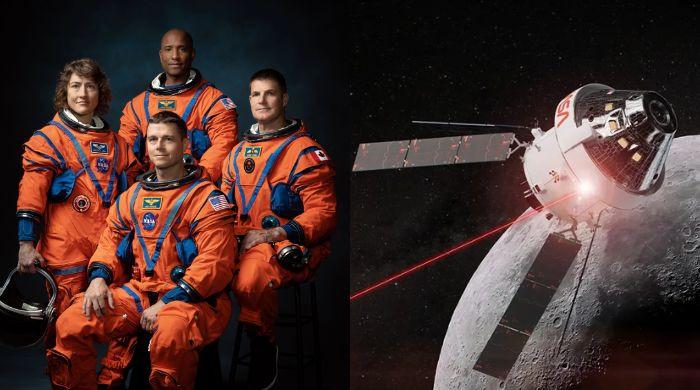
The National Aeronautics and Space Administration (NASA) is taking an important step toward returning humans to the Moon.
This weekend, the agency began rolling its colossal Space Launch System (SLS) rocket and Orion spacecraft toward the launch pad at the Kennedy Space Center in Florida, paving the way for the historic Artemis II mission.
The mission is scheduled to launch on February 6, 2026. It will be the first crewed mission to the Moon since Apollo 17 in 1972.
It will last 10 days and carry four astronauts, including Reid Wiseman (commander), Victor Glover (pilot), Christina Koch (mission specialist) from NASA and Canadian Space Agency astronaut Jeremy Hansen.
The most important point to consider is that Artemis II will not land on the Moon. Rather, it is a critical test flight to authenticate the spacecraft’s systems with a crew on board.
After launch, Orion will complete two orbits around Earth before a powerful engine sends it on a trajectory around the Moon.
The capsule will orbit the far side of the Moon, possibly breaking the record for the farthest distance humanity has ever traveled from Earth, then use the Moon’s gravity to propel it toward Earth, where it will splash down in the Pacific Ocean.
Thanks to this “free return” trajectory, the crew will be able to return to Earth safely without major engine burns after the lunar flyby.
The mission will pave the way for Artemis III by testing Orion’s life support, navigation and communications systems in deep space, with the goal of landing astronauts near the Moon’s south pole by 2028.