
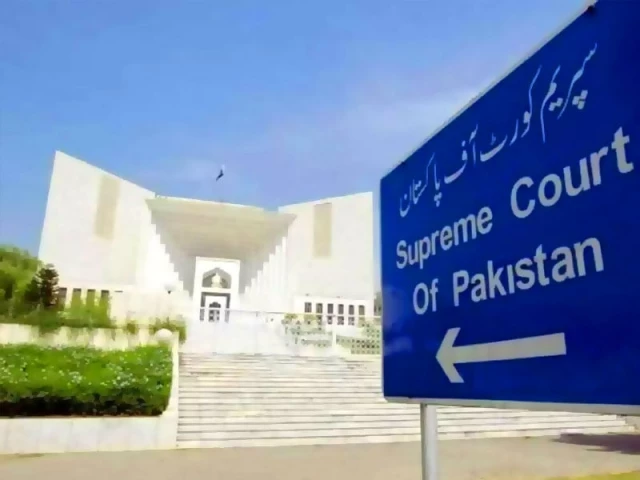
Dismissing a petition for review over objections from the Office of the Registrar, the Federal Constitutional Court (FCC) ruled that the Constitution does not contemplate perpetual litigation because judicial discipline requires that there be an end to judgment. A division bench of the FCC delivered a seven-page judgment, authored by FCC Chief Justice Aminuddin Khan, on a review petition against a Supreme Court order that had upheld the objections of the Registrar’s Office to a plea filed under Article 184(3) of the Constitution. The court found that the motion appeared to be an attempt to "reopen a controversy concluded under the guise of application of the Constitution". He said the jurisprudence of the Supreme Court has consistently reaffirmed that Section 184(3) is not an appellate or review provision. Before the 27th Amendment, the order said, Article 184(3) conferred original jurisdiction on the Supreme Court in matters of public importance relating to the enforcement of fundamental rights guaranteed under Chapter I of Part II of the Constitution.
"The scope and scope of this provision was authoritatively delineated in the Benazir Bhutto case in 1988, in which it was held that the jurisdiction was of an extraordinary character and was intended to deal with matters affecting the general public rather than to serve as a forum for the redressal of individual grievances arising out of concluded litigation." says the judgment.
"The Court emphasized that public importance and respect for fundamental rights are jurisdictional prerequisites and not mere formalities." it continued. "This does not constitute a means of reacting to cases already judged by the regular judicial hierarchy," he added. Rather, the judgment indicates that it is a constitutional mechanism designed to intervene in situations where systemic or structural violations of fundamental rights require immediate constitutional review."
In the present case, the court order said, the petitioner, after pursuing the appeal before the Supreme Court and then the constitutional review petition under Article 188, which was dismissed, invoked Article 184(3).
"It is, in essence, a challenge to a final judicial decision rendered by the Supreme Court in the exercise of its appellate jurisdiction. The constitutional system does not, however, envisage a horizontal appeal against a final judgment… invoking its original jurisdiction," he added.
"It is equally significant that the dispute in question concerns compensation, arising from land acquisition proceedings," the court said, adding that the matter went through the entire judicial hierarchy, including two rounds of appeals in the Supreme Court and a petition filed under Section 184(3).
"The grievance formulated does not involve the application of the fundamental rights of the general public; rather, it is a continuation of a private dispute between the legal representatives of a landowner and the provincial government," the judgment noted. The order held that invoking a review petition against an order sustaining the office’s objection, while dismissing the CM’s appeal which held that the petition filed under Section 184(3) was not competent, therefore appears to be an attempt on the part of the petitioner to reopen a concluded controversy.


