
New court begins hearings in permanent premises as staff shortage remains challenge
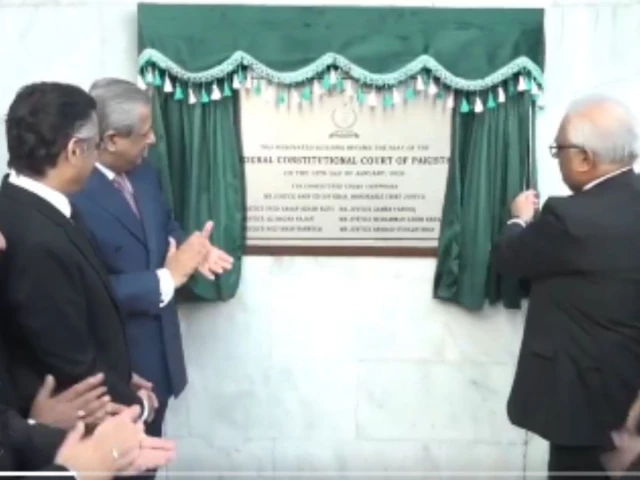
Federal Constitutional Court Chief Justice Aminuddin Khan inaugurates the new FCC building Photo: Express
ISLAMABAD:
The Federal Constitutional Court (FCC), established under the 27th Constitutional Amendment, has officially moved to the Federal Shariah Court (FSC) building in Islamabad, officials said on Monday.
Chief Justice Aminuddin Khan inaugurated the new premises along with other judges.
Three FCC chambers have already begun hearing cases in the FSC building, including a three-member chamber headed by the chief judge that handles supertax cases. Federal Law Minister Azam Nazeer Tarar and Attorney General Mansoor Usman Awan also attended the inauguration.
وفاقی آئینی عدالت کا نئی عمارت میں کام کا آغاز ۔ منتقلی سے پہلے عمارت کی تزئین و آرائش پر کروڑوں روپے خرچ ۔ pic.twitter.com/DK6MTg0MEJ
– Hasnaat Malik (@HasnaatMalik) January 12, 2026
The renovation work on the FSC building, which has been going on for several weeks, is now complete. With the move of the FCC, the Federal Shariah Court will now function from the Islamabad High Court (IHC) building.
The FCC had started operating on November 18 from temporary arrangements at the IHC. More than 45 days after its creation, the court has now moved into its permanent headquarters. A notification issued on December 11 had confirmed that the FCC would operate from the FSC building, while the FSC would be relocated to the IHC.
This arrangement was part of the original plan for the new constitutional court, but the move was delayed due to objections raised by judges of the Federal Sharia Court. During the interim period, several FCC judges, including Chief Justice Khan, continued to work from chambers located in the Supreme Court building.
Read: Newly created FCC facing logistics problems
Despite moving into permanent premises, the FCC continues to face logistical obstacles, including a lack of staff. The Supreme Court approved the transfer of only 20 officials to support the functioning of the court. Besides, 40 judicial officials from Punjab were transferred and some retired Supreme Court officials were appointed.
Of the total 56,608 cases, 22,910 were transferred to the FCC from the Supreme Court. Legal experts say handling such a large volume of cases requires a proportionate increase in staffing levels, which is currently lacking. Observers have also noted that the rate of new cases filed with the FCC is higher than that of the Supreme Court.


