
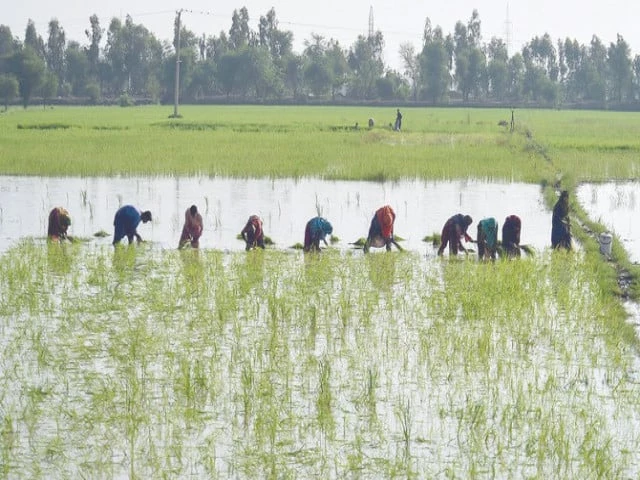
Experts say floodwaters helped recover fisheries, nourish farmland and restore declining ecosystems
Agriculture. Photo: AGENCE ANADOLU
Thatta:
This year, Pakistan’s monsoon season has wreaked havoc across the country – killing more than 1,000 people, washing away livestock and crops and forcing around 3 million people from their homes. Entire areas of Punjab and Khyber Pakhtunkhwa were submerged as rivers burst their banks and towns disappeared beneath floodwaters.
Yet amid widespread destruction, the south coast has seen a rare resurgence. The once-vanishing Indus Delta has come back to life, as floodwaters have revived fishing, nourished farmland and restored ecosystems that had been in decline for decades.
“After a decade, the Indus Delta has released so much water into the sea,” said Iqbal Hyder, a community leader and social worker from the coastal belt. “It benefited fishing communities and agrarian communities in a way we haven’t seen in years.”
Fishermen, in particular, are celebrating a season they had almost given up hoping for.
“This is the first time in 15 years that I have seen fishermen smiling at such massive catches of fish and shrimp,” Hyder told Anadolu.
Emotions were particularly strong over the return of the “palla”, a prized species that swims upstream from the Arabian Sea to breed. Once so abundant that fishermen offered them for free to locals, the fish had become scarce as water levels in the Indus and Delta fell.
The coastal rice crop also thrived this year – another unusual gain.
“Usually we don’t have enough water for the rice crop during the planting season,” Hyder said. “Farmers have not had enough rice not only for themselves, but also to sell it for many years.”
Saeed Ahmad Sethar, senior vice-president of the Sindh Chamber of Agriculture, told Anadolu that the influx of water was also rejuvenating dying mangroves and slowing the incessant marine intrusion that has engulfed thousands of fertile acres and displaced coastal settlements in recent years.
Renaissance of biodiversity
Covering 6,000 square kilometers (2,316 square miles), the Indus Delta is among the world’s 40 most biologically rich ecoregions, home to mangrove forests, wetland habitats and marine nurseries.
“The Indus Delta is a unique and important part of Pakistan’s ecosystem. It supports a rich variety of life, helps protect the coastline and provides essential resources like fish and water purification,” Karachi-based ecologist Rafiul Haq told Anadolu Agency.
He warned that reduced river flow, climate change and human activity have seriously compromised its ecological functions.
But this year’s floods briefly reversed that trend. Fresh water repelled encroaching seawater, revived aquatic species and helped restore wetlands and mangrove forests – all essential for maintaining biodiversity, stabilizing coastlines and storing carbon.
The delta, he added, is essential to the marine food chain. Many species of fish, crabs and shrimp are born in the calm waters of the delta before reaching the open sea.
Floodwaters also replenished depleted groundwater reserves, Haq said.
Temporary reprieve
Agricultural experts warn that relief is fleeting.
“This one-time reprieve will certainly not be enough to reverse a phenomenon that has been eroding local lands for at least three decades due to water shortages,” Sethar said. “But it will still bring a temporary sigh of relief to the Indus Delta and its ecosystem.”
He said agriculture has not been able to maximize the benefits of abundant water due to outdated irrigation methods and poor distribution systems.
“Nature continually gives us opportunities to improve. If we adopt modern water management and appropriate distribution practices – ensuring a minimum level of continuous fresh water supply to the sea, we will not need to rely on flooding to fill the delta and stop erosion,” he said.
Another challenge, he added, is managing floods to minimize damage.
Haq agreed that the benefits would fade unless fresh water supplies were regular.
“These benefits could be sustainable as long as flooding continues to occur periodically,” he said. “However, if their frequency decreases, the benefits could be temporary and the ecosystem could degrade again over time, particularly in regions where groundwater salinity is a problem.”
Dam and irrigation
Environmentalists warn that decades of upstream diversion – through dams and a vast network of canals – have deprived the delta of the water it needs to survive.
“Upstream diversion that continued for more than a century led to an ecological disaster in the Indus Delta,” Islamabad-based water expert Naseer Memon told Anadolu Agency.
He noted that the active area of the delta has shrunk from 13,900 square kilometers in 1833 to just 1,067 square kilometers today, a staggering 92 percent reduction. Seventeen active streams are down to just two.
Memon warned that new upstream canals planned for commercial agriculture would further choke the delta.
For a long-term solution, he said Pakistan must adhere to the minimum flow of water to the sea set out in the 1991 Water Accord.
“Restoration of the Indus Delta is a national obligation,” he said. “An embargo on new upstream diversions is desperately needed for this national asset to survive.”


