
Frontier Corps says fencing, cameras installed to curb infiltration along Afghan border
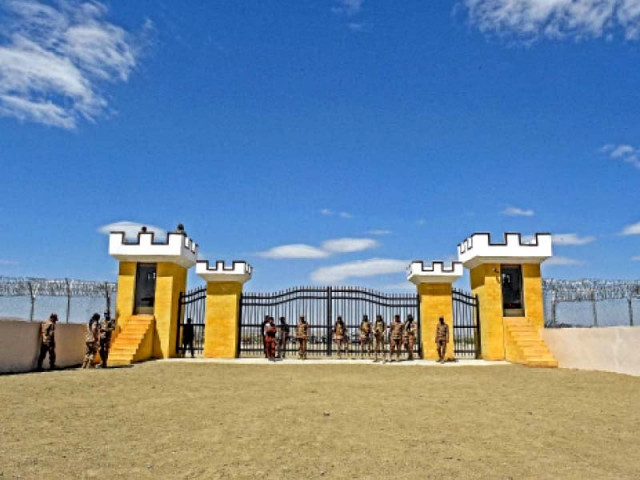
Security personnel of the Frontier Corps guard the skywalk of the newly inaugurated Badini Trade Terminal in Balochistan. PHOTO: AFP
KHYBER PAKHTUNKHWA:
The deteriorating situation in the Tirah Valley has exposed deep-rooted governance failures, with security officials highlighting the absence of basic services, weak administration and limited law enforcement as key challenges in the isolated Khyber Pakhtunkhwa region.
Frontier Corps officials said the vacuum created by poor governance has been exploited by extremist and criminal groups, including Fitna-al-Khawarij, which they accuse of promoting instability and financing activities through drug trafficking and extortion.
Border Corps Inspector General Khyber Pakhtunkhwa North said the province shares a 1,224-kilometer-long border with Afghanistan, of which around 717 kilometers fall under the responsibility of the FC. He explained that the terrain includes steep, snow-capped mountains, high peaks and narrow passes, making border management a complex task.
The IG said cameras had been installed at different locations to counter infiltration, adding that the border can only be fully closed if it is respected by both sides. He noted that the fence between Pakistan and Afghanistan was completed for the first time, transforming it into what can now be called an international border and creating a barrier against uncontrolled movement and infiltration.
Referring to security challenges, the IG said that last year in Bagh Maidan, 64 FC members were martyred and 198 were injured, adding that no other institution had suffered such a high number of casualties in the region. He explained that there are places such as Duatoi where there is a narrow passage but effective control cannot be carried out due to lack of legal authority.
He further highlighted that only three police officers are currently deployed to monitor the entire local population, highlighting the serious shortage of law enforcement resources.
Wing Commander Colonel Waqas said the absence of civil administration was glaring, pointing out that for a distance of up to 60 kilometers in the Tirah Valley, there was no district administration, police presence or hospital. He said there were no public schools in the area and no designated teachers, depriving children of education.
“When children do not go to school and are denied education, awareness does not develop and they are pushed into illegal activities,” he said.
Col Waqas said the FC runs 16 schools in the valley and has recruited teachers itself to provide basic education. He added that there is no hospital in the area and residents often turn to the FC even for basic medical needs such as injections. The FC, he explained, also organizes free medical camps for the local population.
He described drug trafficking as a major problem in the Tirah Valley, alleging the involvement of Fitna-al-Khawarij. He said funds generated from drug trafficking and extortion are used against security forces and civilians.
Officials warned that persistent mismanagement and failure of local governance structures are allowing militant and criminal elements to take deeper roots in the region, worsening security and humanitarian challenges for the local population.


