
Advises the public not to pay attention to rumors, as the oil supply situation in the country remains stable
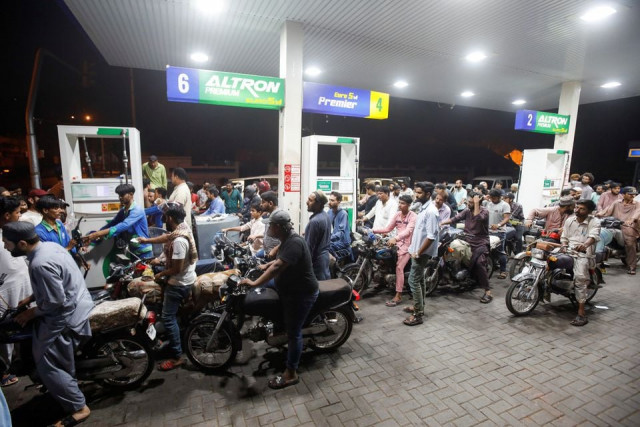
People wait for their turn to get fuel at a gas station, in Karachi, Pakistan, June 2, 2022. Picture taken June 2, 2022. PHOTO: REUTERS
The government on Thursday ordered all provinces to direct deputy commissioners (DCs) to carry out inspections in their respective jurisdictions to monitor illegal hoarding of petroleum products for profit, as tensions in the Middle East continue to escalate.
The statement followed reports of an oil shortage in the country. Leaders of the Pakistan Petroleum Traders’ Association (PPDA) have raised the alarm, alleging that oil companies have cut supplies and warned that petrol pumps could start shutting down in the coming days if supplies are not restored.
Central Punjab Speaker Nauman Majeed said oil supplies had also been reduced by 50%. He alleged that some private companies had started hoarding petroleum products.
A statement issued by the Oil and Gas Regulatory Authority (OGRA) highlighted concerns over possible hoarding attempts, with reports suggesting that some elements could exploit the current situation to take advantage of the fuel shortage.
“To combat such practices, all provincial chief secretaries have been asked to direct deputy commissioners (DCs) to carry out inspections in their respective jurisdictions. Any premises involved in illegal storage of petroleum products will be sealed and action will be taken in accordance with law,” the OGRA said.
At the same time, OGRA teams are actively monitoring the situation on the ground. Inspections are carried out at oil depots and retail outlets to ensure the proper supply of petroleum products and prevent malpractices.
“The public is advised not to pay attention to rumors and continue with their normal consumption patterns, as the oil supply situation in the country remains stable,” the statement added.
The government has reassured citizens that the country has sufficient stocks of petroleum products to meet national demand and there is no need to panic or hoard.
Learn more: War in Iran: Pak plans to import oil via Red Sea
“Considering the current geopolitical situation, authorities are closely monitoring the oil supply chain to ensure uninterrupted availability of products across the country. The existing stock position remains comfortable and in compliance with prescribed requirements,” OGRA said.
The authority also stressed that strict action would be taken against any person or entity involved in illegal hoarding or storage of petroleum products at unauthorized places, especially at places other than licensed oil depots and retail outlets of petroleum marketing companies (OMCs).
Oil for 28 days
The Oil and Gas Regulatory Authority has already clarified that it has high oil stocks to meet the country’s consumption needs for 28 days, following preventive measures to import surplus fuel.
However, due to the US-Israeli attack on Iran, two crude oil shipments remained stranded after the Strait of Hormuz was closed. This canal is 33 km wide and passes through a fifth of the world’s oil.
Last year, the Strait of Hormuz was used to ship an average of 20 million barrels of crude, condensate and fuel per day. OPEC members like Saudi Arabia, Iran, the United Arab Emirates, Kuwait and Iraq rely on this sea route to export most of their crude, mainly to Asia. “We have sufficient stocks of gasoline and diesel to meet the country’s needs,” officials said, adding that the country could meet consumers’ fuel needs for 28 days.
However, the government planned to import oil via the Red Sea from Saudi Arabia and the United Arab Emirates (UAE) due to the closure of the Strait of Hormuz, while also moving to a weekly oil price review mechanism.
Read also: Fuel-saving plan unveiled as Iran war chokes supplies
Sources said The Express PK Press Club that the government is currently working on various measures to ensure uninterrupted oil supplies in the context of the war between the United States, Israel and Iran.
Pakistan imports around one million barrels of oil every month, with Saudi Arabia being one of the country’s largest oil exporters. The UAE also exports oil to Pakistan.
Sources said UAE-based ADNOC and Saudi Aramco would supply oil to Pakistan bypassing the Strait of Hormuz. A refinery has already imported some cargoes via the Red Sea. A few oil tankers have reached Pakistan, while others are on their way.
In another measure, the government is considering moving the review of oil prices from the existing fortnightly system to a weekly basis. The objective is to discourage the hoarding of petroleum products by resellers.
Sources said the government was planning a possible hike of Rs 50 per liter in oil following the recent war in the Gulf region.


