
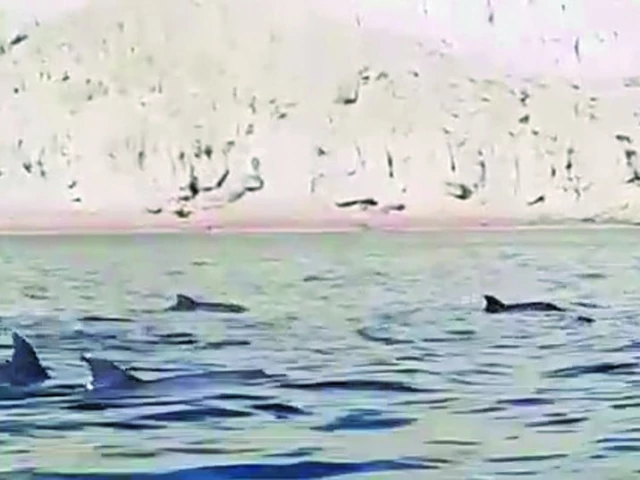
Dolphin. Photo: Express
KARACHI:
Despite the sea’s unusual green color caused by a seasonal marine phenomenon, Gwadar’s coastal waters remain rich in marine life, with pods of bottlenose dolphins recently spotted in the port city’s western bay.
According to a statement released by WWF-Pakistan, a winter marine phenomenon known as the Noctiluca bloom has led to widespread green discoloration of sea water across the entire coast of Pakistan, extending from Karachi to Jiwani, with the phenomenon also extending to the coastal waters of Iran.
The bloom has turned the sea water a dark green color in several areas, especially around Gwadar.
Despite the dense green water, the Gwadar Sea remains rich in marine life. WWF says the natural phenomenon did not disrupt fishing activity.
Local fisherman Ameer Dad Khan reported that over the past few days, shrimp catches along the Balochistan coast have been abundant and larger in size, indicating stable marine conditions.
Balochistan Director of Marine Fisheries Ahmed Nadeem confirmed on Sunday morning that a large number of dolphins were sighted in the western bay of Gwadar.
Commenting on the situation, WWF technical advisor Muhammad Moazzam Khan explained that such color changes in the sea are generally non-toxic and often increase marine productivity.
He said Noctiluca blooms only cause mortality in extreme cases. This disease, locally called “badd aab” in Balochi, occurs periodically in the Arabian Sea, with higher frequency during the winter months.
However, he stressed that fishing activity has not been affected and that fishermen are continuing their usual operations without interruption.
Moazzam Khan said the sighting of bottlenose dolphins in Western Gwadar Bay was an encouraging sign, adding that it confirmed that the condition of the green sea had not negatively affected the marine biodiversity of the region.


