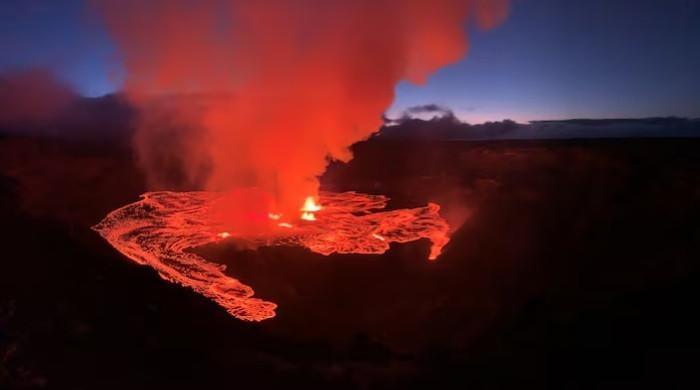
LOS ANGELES: Fountains of fresh lava gushed spectacularly Saturday from Hawaii’s Kilauea volcano, U.S. volcanologists said, marking nearly a year since one of the world’s most active volcanoes began erupting.
“Sustained lava fountains approximately 50 to 100 feet (15 to 30 meters) in height are currently gushing from the northern vent,” the U.S. Geological Survey’s Hawaiian Volcano Observatory said in a statement, adding that “the height of the fountains is increasing rapidly.”
The latest episode of the ongoing eruption – the 38th wave of molten rock and gas from deep underground – began at 8:45 a.m. local time (18:45 GMT), the USGS said.
Such activity has been intermittent since the eruption began on Dec. 23, 2024, the USGS said, and generally continues “for a day or less.”
All eruptive activity is “confined to Halema’uma’u Crater in Hawaii Volcanoes National Park,” the service said, and local airports are not expected to be affected by gas or volcanic ash.
Authorities are monitoring high levels of volcanic gas and a phenomenon called “Pele’s hair,” in which strands of volcanic glass “often produced by lava fountain activity” are “transported more than 10 miles (15 kilometers) from the vent.”
Hot, glassy volcanic fragments “may fall to the ground within 1 to 2 miles (1 to 3 kilometers) of eruptive vents.”
Kilauea has been very active since 1983 and erupts relatively regularly.
It is one of six active volcanoes located in the Hawaiian Islands, which also includes Mauna Loa, the largest volcano in the world.
Kilauea is much smaller than its neighbor Mauna Loa, but is much more active and regularly wows helicopter tourists who come to see its searing spectacles.