
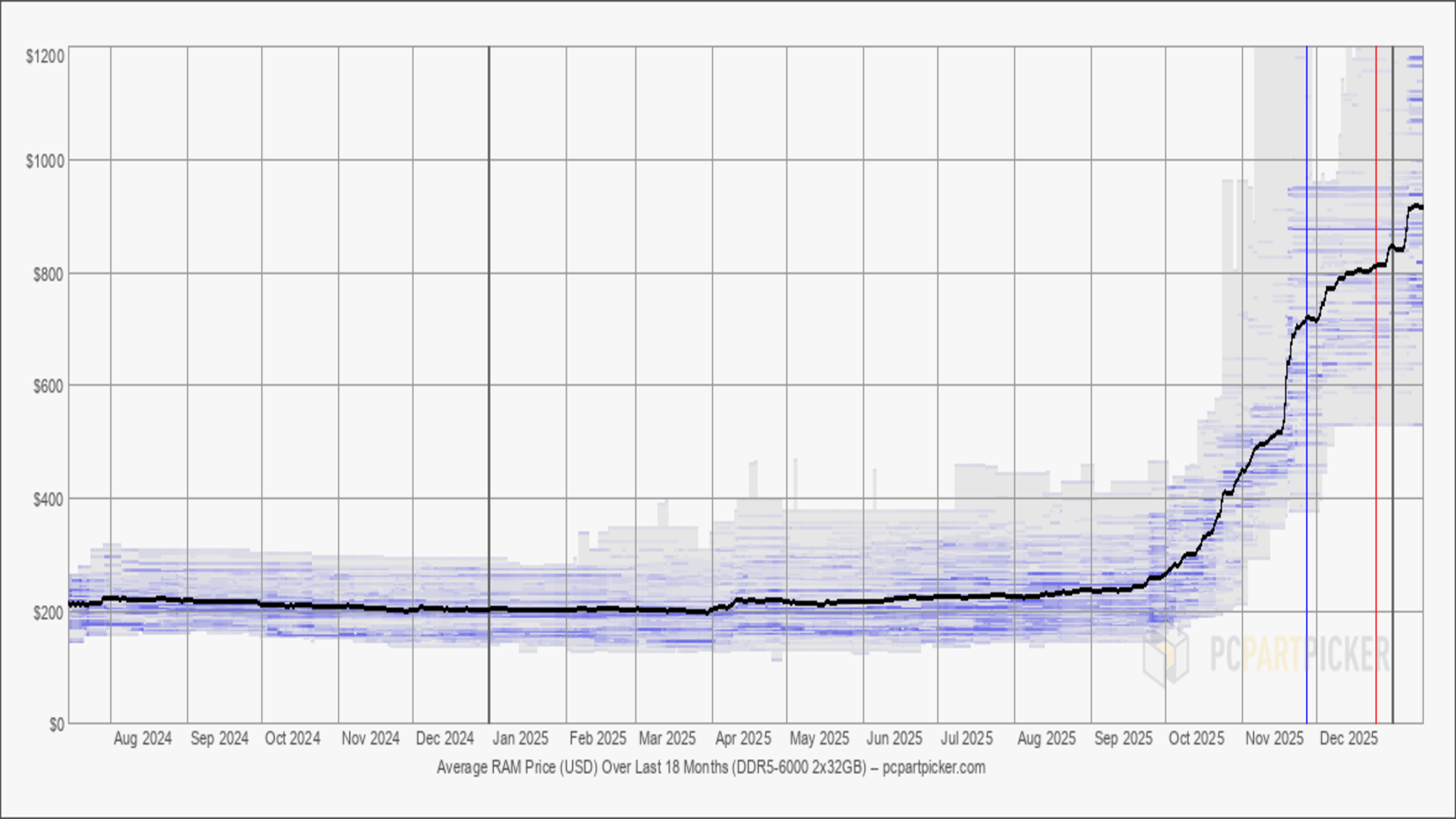
- Prices for high-capacity DDR5 quadrupled in a matter of weeks during the 2025 quarter
- DDR5-5600 and DDR5-6000 evolved in sync despite different specifications
- Data from early 2026 indicates strong weekly increases have largely paused
It’s become increasingly difficult to ignore the rising cost of DRAM in recent months, especially for higher capacity DDR5 kits.
If recent reports are to be believed, the situation is unlikely to improve any time soon, but rather appears to be a stepping stone to even higher costs.
Estimates for early 2026 indicate that contract prices could rise sharply from late 2025 levels, and TrendForce now projects that DRAM prices will increase by approximately 55-60% in the first quarter of 2026.
High prices may be responsible for stability
A recent average market price trend by PCPartPicker (PPP) reveals that the pricing situation could improve, especially for high-end models.
The trend shows that for much of the past 18 months, prices for high-capacity DDR5 memory kits have remained within a relatively narrow range.
Models such as the DDR5-5600 and DDR5-6000 in 2 x 32 GB configurations have spent most of this period clustered just above the $200 level.
However, this prolonged stability came to an abrupt end during the final quarter of 2025, when pricing behavior changed within a few weeks.
Between October and December 2025, average prices for 2x32GB DDR5-5600 increased from just over $200 to around $800.
During the same period, DDR5-6000 2x32GB has increased further, reaching around $900 on average.
Given the magnitude of this increase, it is unlikely to be due to routine cost adjustments or incremental improvements.
Although DDR5-6000 kits generally have slightly higher prices than DDR5-5600 kits, the difference remained inconsistent for much of the observed period.
At one point, both configurations sold at nearly identical levels, indicating that rated speed alone does not reliably influence pricing.
Once prices started to rise, both models moved in the same direction and in the same time frame, implying that the price of high-capacity memory continued to increase week after week, regardless of individual rating.
However, since the start of 2026, the pace of weekly price increases has slowed noticeably, as early data shows little evidence of a continued strong rise in these high-end kits, suggesting prices have stabilized for the time being.
This stabilization, however, occurred at levels much higher than those previously observed. An average price close to $900 for 64GB is a lot of money after all.
Therefore, current price stabilization probably says less about better market conditions than about a limited willingness to buy at current prices.
After all, demand determines supply, and if there is no increase in demand, prices will remain stable or even fall – but it remains to be seen whether this price plateau will continue or whether DDR5 memory prices will fall.
Follow TechRadar on Google News And add us as your favorite source to get our news, reviews and expert opinions in your feeds. Make sure to click the Follow button!
And of course you can too follow TechRadar on TikTok for news, reviews, unboxings in video form and receive regular updates from us on WhatsApp Also.


