
Statement regarding EFF, says viewing measures as sudden and unexpected reflects lack of knowledge of the facts
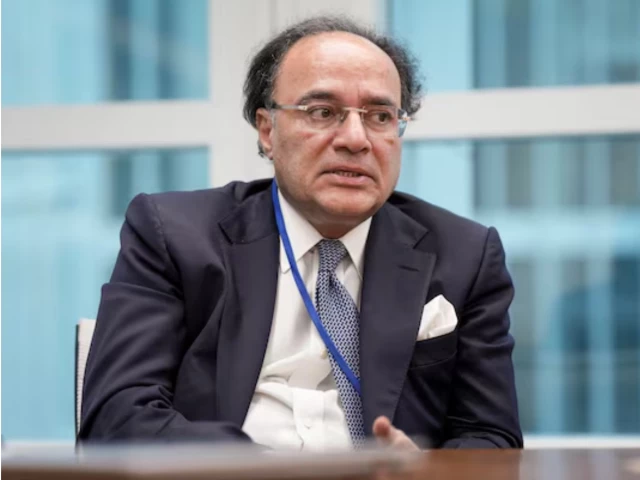
Finance Minister Muhammad Aurangzeb speaks during an interview with Reuters at the 2025 Spring Annual Meetings of the IMF and the World Bank in Washington, DC, United States, April 25, 2025. Photo: Reuters/File
The Ministry of Finance clarified, in a press release on Sunday, that there is nothing new in the conditionalities of the IMF’s Extended Financing Facility (EFF). He said that the Memorandum of Economic and Financial Policies (MEFP) is a continuation of the agreed reform program, implemented in a progressive manner for the economic stability and sustainable growth of the country.
At the start of the IMF program, the Government of Pakistan presented its reform policy proposals, which the IMF gradually integrated into the MEFP. The ministry said treating these situations as sudden or unexpected new conditions reflects a lack of knowledge of the facts.
Read: IMF conditionalities
The EFF reflects an agreed medium-term reform strategy, with the government already implementing many of the reforms included in it. Medium-term structural reforms are implemented in stages, with new measures included in each IMF review to gradually achieve the final objectives agreed at the start of the program.
The MEFP agreed after the second review is a continuation of the MEFP from the first review, the ministry said. The issue of publishing civil servants’ asset declarations has been included in the EFF from May 2024, with the current structural benchmark being the logical next step following amendments to the Civil Service Act 1973.
Improving the performance and autonomy of the NAB has been agreed in previous reviews. Strengthening the performance of the NAB and cooperation with other investigative agencies is part of this continuity, a measure that was agreed before the diagnostic report on governance and corruption. Granting provincial anti-corruption institutions access to financial information is part of the anti-money laundering and anti-terrorist financing (AML/CFT) reforms, which have been part of the EFF program since the beginning, the ministry said.
The government has discouraged informal channels to increase remittances, resulting in a 26% year-on-year increase in FY 2025, with a 9.3% increase in remittances expected in FY 2026. The government, together with the State Bank, is working to reduce the cost of remittances, with the IMF including these measures in the MEFP.
Learn more: IMF imposes 11 new conditions on Pakistan’s $7 billion bailout package
The ministry noted that a study on the development of the local currency bond market was recommended in May 2025 and is now included in the program as a structural reference.
Furthermore, the statement highlighted that the reforms in the sugar sector are an initiative of the Pakistani government itself, with the Prime Minister’s Office constituting a task force under the leadership of the Minister of Energy. The working group prepares recommendations in consultation with the provinces. This initiative is aligned with the objectives of the EFF, aimed at reducing state intervention in commodity markets, and the IMF has therefore integrated it into the MEFP.
The FBR reforms are part of the government’s broader revenue improvement agenda, with the task force headed by Prime Minister Shehbaz Sharif himself, the ministry said. Over the past year, the transformation plan was approved, the Office of Tax Policy was established and measures such as improving compliance risk management were taken.
The separation of tax policy from the operational functions of the FBR was a major step, with the preparation of the medium-term tax reform strategy being a continuation of this process.
Read also: Pakistan receives $1.2 billion as IMF releases EFF and climate finance funds
The privatization of distribution companies (DISCO) has also been part of the FEP program since its creation and must be carried out in stages. Finalizing the conditions for private sector participation in the privatization of the Hyderabad and Sukkur power supply companies is an agreed measure, the statement said. The public service obligation agreements concluded with seven large DISCOs are also a continuation of the agreed measures.
Amendments to the Companies Act 2017 aimed at reforming regulations and improving the business environment are part of wider reforms. The Concept Note on Amendments to the Special Economic Zones (SEZ) Law is the next step following the previous SEZ Review Study.
Alternative measures for potential revenue shortfalls have always been part of the MEFP, the ministry noted, with the initial MEFP dating from May 2024 also including a structural benchmark to introduce a 5% federal excise duty on agricultural fertilizers and pesticides.


