
Spokesperson credits EFF reforms with stabilizing inflation ahead of crucial review
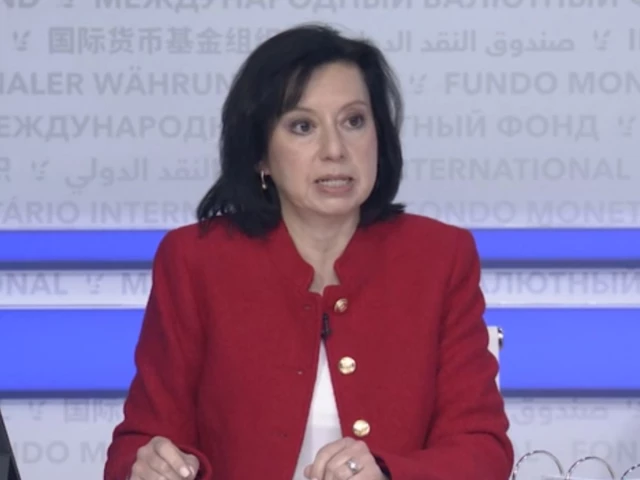
Julie Kozack, IMF communications director, addressing a news conference Thursday. PHOTO: SCREENSHOT
ISLAMABAD:
The International Monetary Fund (IMF) has acknowledged a marked improvement in Pakistan’s economic outlook, saying policy efforts under its Extended Financing Facility (EFF) have helped stabilize the economy, contain inflation and restore confidence, as the country prepares for a new round of review talks later this month.
Speaking at a press briefing in Washington, IMF Communications Director Julie Kozack said an IMF staff team would visit Pakistan starting February 25 to hold discussions on the third review of the Extended Fund Facility (EFF) and the second review of the Resilience and Sustainability Mechanism (RSF).
Kozack described Pakistan’s fiscal performance in fiscal 2025 as “strong,” noting that the country achieved a primary budget surplus of 1.3 percent of gross domestic product (GDP), a figure that meets the agreed targets of the program.
She added that overall inflation remained relatively contained. Significantly, she added, Pakistan recorded its first current account surplus in 14 years in fiscal 2025, signaling an improvement in external sector stability.
The IMF said these results reflect the impact of reforms undertaken under the EFF program. The upcoming review discussions will assess Pakistan’s progress on reform benchmarks and determine next steps on disbursements, the spokesperson said.
An IMF mission led by Mission Chief Iva Petrova is expected to arrive in Karachi on February 25 for discussions with the State Bank of Pakistan (SBP) before heading to Islamabad. Formal negotiations with federal and provincial authorities are expected to begin on March 2 and end around March 11.
Once the review is completed, Pakistan will become eligible for the release of around $1 billion under the EFF and another $200 million under the RSF by the end of April.
Kozack also referred to the recently released Pakistan Governance and Corruption Diagnostic Report, which outlines proposals for structural reforms. These include simplifying tax policy design, improving the transparency of asset declarations and leveling the playing field in public procurement.
The IMF has placed particular emphasis on the simplicity and transparency of the tax system and on strengthening monitoring of public procurement processes. The simplification of tax policy has been identified as one of the most important reform priorities of the programme.
The review will also examine the implementation of the recommendations of the governance and corruption diagnostic and the national fiscal compact. Performance through the end of December 2025 remained largely on track, although revenue shortfalls were noted, with authorities indicating these could narrow following a recent ruling by the Federal Constitutional Court in favor of the government on supertaxation.
The Extended Fund Facility is a longer-term IMF loan arrangement aimed at helping countries address deep-rooted economic weaknesses and balance of payments problems over the medium term. According to the Fund, policy measures taken by Pakistan under the program have contributed to stabilization and renewed confidence among international financial institutions.


