- The official signing will take six months, an Indian government official said.
- Implementation of the agreement is expected within a year.
- Trade between the two sides amounts to $136.5 billion for fiscal 2025.
India and the European Union have concluded negotiations on a coveted trade deal that will be announced on Tuesday, the South Asian nation’s commerce secretary said Monday, a deal both sides hailed as historic as they face strained relations with the United States.
The agreement paves the way for free trade in goods between the bloc of 27 European countries and India, which together represent a quarter of the world’s gross domestic product and a market of 2 billion consumers.
“This will be a balanced and forward-looking agreement for better economic integration with the EU. The agreement will propel trade and investment between the two sides,” Indian Commerce Secretary Rajesh Agrawal said.
Trade between the two sides amounted to $136.5 billion in the fiscal year through March 2025.
A wave of trade agreements
The formal signing would take place after a legal vetting that is expected to take five to six months, an Indian government official familiar with the matter said.
“We hope the agreement will be implemented within a year,” the official added.
The deal comes days after the EU signed a crucial agreement with South American bloc Mercosur, following last year’s deals with Indonesia, Mexico and Switzerland.
During the same period, New Delhi finalized agreements with Britain, New Zealand and Oman.
The flurry of deals underscores global efforts to protect against the United States, as President Donald Trump’s attempt to seize Greenland and tariff threats against European countries test long-standing alliances between Western countries.
After nearly two decades of on-and-off negotiations, the deal will see India open its vast and protected market, the world’s largest, to free trade with the EU, its largest trading partner.
Accelerated negotiations agreed last year
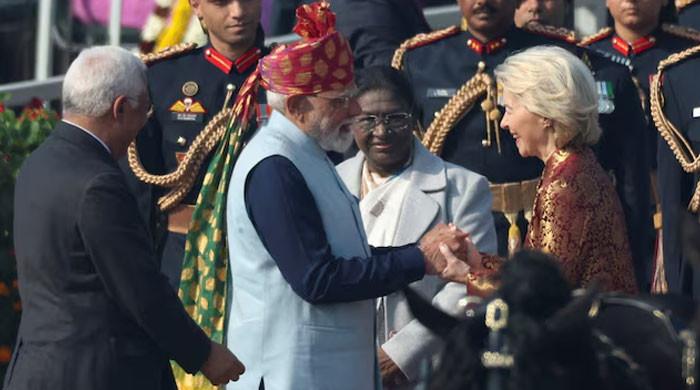
India and the EU pushed to seal the deal after Prime Minister Narendra Modi and European Commission President Ursula von der Leyen agreed to accelerate negotiations last year.
Bilateral negotiations, restarted in 2022 after a nine-year lull, gained momentum after Trump imposed import tariffs on several trading partners, including a 50% duty on goods from India.
A trade deal between India and the United States collapsed last year after a breakdown in communication between the two governments.
The EU and India were engaged in last-minute concessions on auto and steel trade, one of the latest points of contention.
The EU had asked India to slash import duties on its cars, which can exceed 100%, while India – a major steel producer – has pushed the EU to reduce trade restrictions on its steel exports.
Reuters reported on Sunday that India plans to cut tariffs on cars imported from the EU from 110% to 40%, as part of the deal.
Negotiations have excluded some sensitive agricultural and dairy products as New Delhi maintains the need to protect millions of subsistence farmers.