
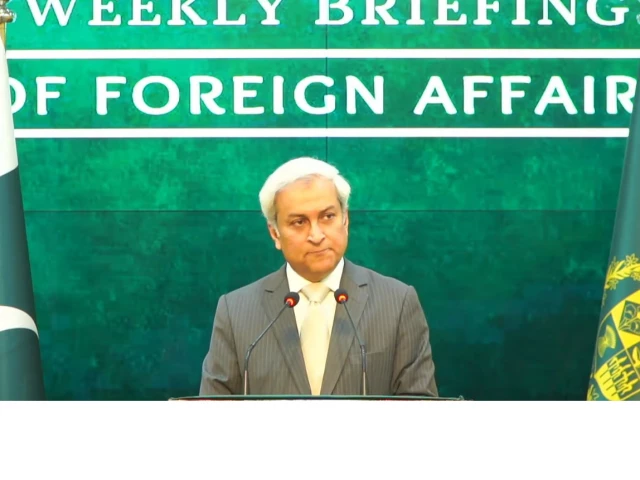
The spokesperson says India has failed to bring to justice those involved in the Samjhauta Express attack.
Foreign Ministry spokesperson Tahir Andrabi speaks to the weekly press on February 26, 2026. Photo: MoFA/X
Foreign Ministry Spokesperson Tahir Andrabi on Thursday stressed that the reaction of the Indian Ministry of External Affairs (MEA), following the recent terrorist attack in Balochistan, effectively corroborated Pakistan’s long-standing position regarding external involvement in destabilizing activities.
Speaking at a weekly press briefing, FO spokesperson Tahir Hussain Andrabi said India’s remarks also followed a recent terrorist attack in Balochistan, which Pakistan said highlights India’s role in promoting extremist activities in the region.
“And in light of the terrorist incident in Balochistan, India’s comments indeed confirm Pakistan’s position,” he said.
Read also: 34 dead in Balochistan, KP anti-terrorist operation
Andrabi also marked the 19th anniversary of the Samjhauta Express attack in 2007, which killed more than 70 people. He said the accused, including Swami Aseemanand, Indian Army officer Lt Col Purohit and former BJP lawmaker Sadhvi Pragya Singh Thakur, had publicly admitted their involvement but remained free.
“The four convicts involved in the Samjhauta Express attack are still free. India has failed to bring them to justice,” he said, describing India’s systemic exoneration of the perpetrators as proof of state complicity in terrorism against Pakistan.
Andrabi added that the current Indian regime has allowed Hindutva extremism and saffron terror, which motivated the attack almost two decades ago, to intensify. He demanded a fair trial in which all perpetrators and accomplices of the Samjhauta Express attack are held accountable, adding that the families of the victims deserve justice.
🔴LIVE: Weekly press briefing by the spokesperson 26-02-2026 at the Ministry of Foreign Affairs, Islamabad
— Ministry of Foreign Affairs – Pakistan (@ForeignOfficePk) February 26, 2026
The spokesperson also highlighted Prime Minister Shehbaz Sharif’s visit to Qatar on February 23-24 at the invitation of the Emir, who expressed his desire to strengthen economic ties. During the visit, the Prime Minister also met the Minister of Defense and Minister of State of Qatar, he said.
He said the two leaders reviewed the overall bilateral relations and expressed satisfaction with the positive trajectory of political engagement. They stressed the importance of strengthening cooperation in all areas of mutual interest, particularly in trade, investment and economic collaboration.
The Emir of Qatar reiterated his commitment to deepening economic partnership with Pakistan at a higher strategic level. The two sides also exchanged views on regional and international developments, emphasizing dialogue, diplomacy and peaceful resolution of disputes.
Deputy Prime Minister/Foreign Minister Senator Mohammad Ishaq Dar @MIshaqDar50 arrived in Saudi Arabia for a two-day visit to participate in the extraordinary open-ended ministerial meeting of the OIC Executive Committee.
He was received at the King Abdulaziz International… pic.twitter.com/oglzdCTM5v
— Ministry of Foreign Affairs – Pakistan (@ForeignOfficePk) February 26, 2026
Andrabi further said that Deputy Prime Minister and Minister of Foreign Affairs Ishaq Dar was on an official visit to Saudi Arabia from February 26 to 28 to participate in an extraordinary ministerial session of the Executive Committee of the Organization of Islamic Cooperation (OIC), which is being held in Jeddah today.
The emergency session was convened to review what Pakistan described as illegal decisions by Israeli occupation authorities to expand settlements, pursue annexation and impose sovereignty over the occupied West Bank.
At the ministerial meeting, Dar will present Pakistan’s view on Israeli moves to convert areas of the occupied West Bank into what he called “so-called state lands.” On the sidelines of the session, he is also expected to hold bilateral meetings with foreign ministers of OIC member states.
The spokesperson noted that Pakistan joined the joint statements by OIC members and other countries strongly condemning recent Israeli actions extending illegal control over the West Bank, calling these measures violations of international law and threats to regional peace and stability.


