
Araghchi says he is ready and “waiting” for the American invasion; Tehran strike sparks fire at Bahrain refinery
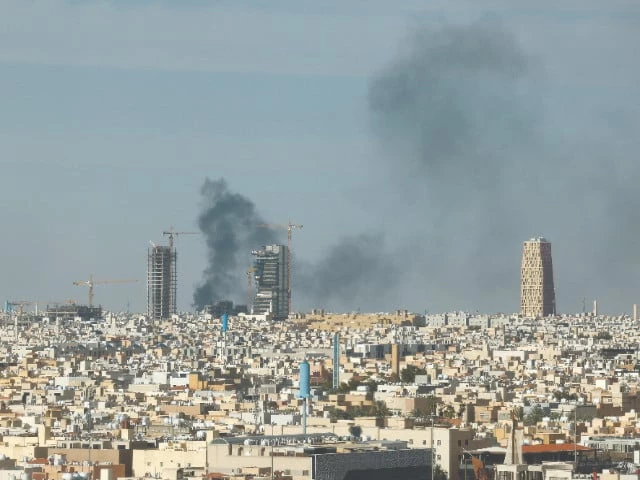
Smoke rises above the rooftops of the city of Riyadh, amid the US-Israeli conflict with Iran. Photo: Reuters
WASHINGTON:
Iran is “waiting” and ready to counter any ground invasion by the US military, Foreign Minister Abbas Araghchi said on Thursday, as the Middle East war sparked by US-Israeli attacks on Iran has spread to Cyprus, Sri Lanka, Turkey and Azerbaijan, and risks drawing more countries into the conflict.
Additionally, a spokesperson for the Khatam al-Anbiya Central Headquarters said that the aircraft carrier USS Abraham Lincoln was struck by IRGC naval drones and that, along with the accompanying destroyers, they fled the area at high speed. The carrier has so far moved more than 1,000 kilometers away from the region.
The foreign minister said his country had learned lessons from previous conflicts and now had a more capable fighting force capable of confronting US troops in the event of an invasion.
“When I said we expected them, that didn’t mean we expected the war to continue. No, but we have prepared to face any scenario, any eventuality, any possibility, and we know we can handle it,” he said.
“The conflict has escalated into a high-intensity, multi-domain campaign with no immediate end in sight,” the US-based Soufan Center said.
“The conflict has expanded beyond direct military exchanges and conventional strikes to become a regional conflict including leadership decapitation strikes, internal destabilization efforts, pressure on maritime choke points, attacks or threats against energy infrastructure, and economic coercion.”
A US submarine sank an Iranian warship off the coast of Sri Lanka on Wednesday, killing at least 84 people on board.
Iranian Foreign Minister Abbas Araghchi accused the United States of carrying out “an atrocity at sea” and said Washington would “bitterly regret” setting the precedent.
Iran, meanwhile, has struck targets all over the Middle East – but also beyond.
An Iranian-made drone struck a British military base in EU member Cyprus on Monday.
On Wednesday, NATO air defense systems intercepted a ballistic missile launched from Iran and heading towards Turkey.
It remains unclear whether the missile deliberately targeted Turkey, but Foreign Minister Hakan Fidan warned his Iranian counterpart that “any measures that could lead to the spread of conflict must be avoided.”
On Thursday, at least two drones from Iran attacked the Azerbaijani enclave of Nakhichevan, with Baku – an ally of Israel – vowing that the incident “will not go unanswered”.
“Iran is striking everywhere, targeting potential allies or potentially neutral countries,” a European military source told AFP.
“Perhaps the calculation is to adopt an indirect strategy aimed at crippling the global economy and increasing the cost of war for the United States.”
He said Iran was not asking for a ceasefire and saw no reason to negotiate with the United States.
“We negotiated with them twice and each time they attacked us in the middle of the negotiations. So we have no demand for a ceasefire, and we have no demand for negotiations with the United States,” he said.
Araghchi insisted the United States had “failed” to achieve a quick victory and regime change in Iran, despite a U.S.-Israeli strike that killed Supreme Leader Ayatollah Ali Khamenei last week.
An Iranian missile strike on Thursday sparked a fire at Bahrain’s main state-owned oil refinery as Iran continued its attacks across the Gulf for a sixth day.
Some staff at the Western embassy in Riyadh have meanwhile been ordered to shelter in place, diplomatic sources said, following an attack on the US embassy compound earlier this week.
War in the Middle East has engulfed the otherwise stable Gulf region as Iran responds to U.S. and Israeli strikes that killed its supreme leader, launching attacks on Israel, the wider region and beyond.
At least 13 people have been killed in the Gulf, including seven civilians, since Iranian strikes began on Saturday. Washington said six U.S. service members were killed, including four in Kuwait.
A fire broke out at the Bapco Energies refinery in Bahrain following the Iranian attack, but was later brought under control, the kingdom’s communications center said.
No injuries were reported in the attack at the Sitra island refinery and operations continued, the government media arm added.
Earlier, Britain announced it was temporarily withdrawing some embassy staff and their dependents from Bahrain due to the security situation.
US President Donald Trump insisted Thursday that he will have a say in choosing Iran’s next supreme leader, as the war sparked by the US-Israeli campaign that killed Ayatollah Ali Khamenei reverberated across the Middle East and beyond.
Earlier, Israel issued an unprecedented evacuation warning for the entire southern suburbs of Beirut, a stronghold of Iran-backed Hezbollah, prompting residents to flee the neighborhood of hundreds of thousands of residents in panic.
This warning followed a new wave of Israeli attacks against Iran, which again targeted Gulf countries.
The war has drawn in world powers, straining shipping and shaking energy markets. It was felt as far away as the shores of Sri Lanka, where a US submarine torpedoed an Iranian warship, and in Azerbaijan, which threatened retaliation after a drone struck an airport.
Trump on Thursday dismissed the possibility that Khamenei’s son, Mojtaba Khamenei, would replace his murdered father as supreme leader, calling the young man a “lightweight.”
“I have to be involved in the nomination, like with Delcy,” Trump told Axios in an interview, drawing a comparison to Venezuela, where interim President Delcy Rodriguez cooperated with him under threat of violence after the United States ousted his boss, Nicolas Maduro.
“Khamenei’s son is unacceptable to me. We want someone who will bring harmony and peace to Iran,” Trump reportedly said, threatening to continue the war in the future if a better alternative was not found.
The remarks suggest a willingness to work with someone from inside the Islamic republic rather than completely overthrow the government, despite Trump’s repeated exhortations to Iranians to rise up and take back their country.
Lebanon was drawn into a widening conflict on Monday when the Iranian-backed militant group Hezbollah attacked Israel to avenge Khamenei’s killing.
Israel responded with airstrikes and sent ground troops to some Lebanese border villages. He asked residents of much of southern Lebanon to leave in anticipation of military operations.
In a message to residents of the southern Beirut suburb known as Dahiyeh on Thursday, an Israeli army spokesperson said: “Save your lives and immediately evacuate your residences.”
Such warnings usually foreshadow large-scale attacks and massive traffic jams formed on the outskirts of suburbs, as people fired into the air, urging residents to leave as soon as possible.
On a beach in Beirut, hundreds of families, many of them scared and angry, gathered after hastily fleeing with nowhere to go.
“We fled the suburbs, we were humiliated,” one man told AFP, refusing to give his name.
“We will sleep on the road tonight and only God knows what will happen to us.”
Lebanese President Joseph Aoun asked his French counterpart Emmanuel Macron to intercede with Israel to prevent the bombing of southern Beirut.
“At this moment of great danger, I call on the Israeli Prime Minister (Benjamin Netanyahu) not to extend the war to Lebanon,” Macron said after the conversation.
Earlier in the day, Israel said its forces had struck “several command centers belonging to the terrorist organization Hezbollah” in south Beirut.
Pakistan also expressed serious concern over the attacks on Turkey and Azerbaijan.
“Pakistan expresses its deep concern over the recent attacks targeting brotherly countries Turkey and Azerbaijan. These attacks constitute a blatant violation of international law and principles of interstate relations and could push the region towards further escalation,” the Ministry of Foreign Affairs said in a statement.
While reaffirming Pakistan’s strong solidarity with Turkey and Azerbaijan, we call for restraint and recourse to dialogue and diplomacy to maintain regional peace and stability, the statement added.


