
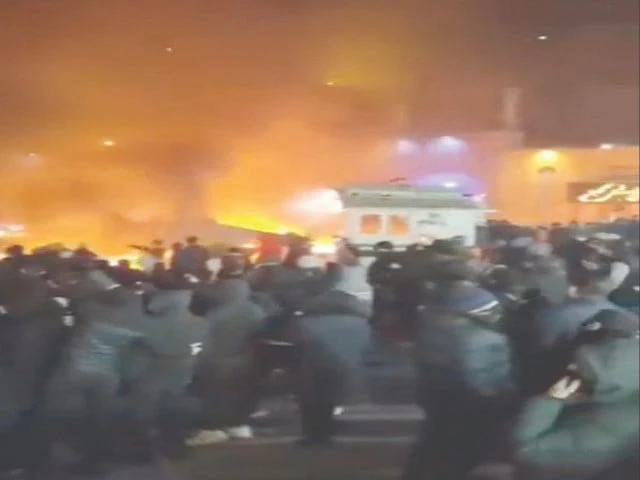
A screenshot obtained from a social media video posted Friday shows protesters gathering as vehicles burn amid the evolving anti-government unrest in Tehran. Photo: AFP
LONDON/PARIS:
Iran plunged into a near-total internet blackout on Friday as authorities moved to quell the biggest wave of anti-government protests in more than a decade, with Supreme Leader Ayatollah Ali Khamenei striking a defiant tone and insisting that the Islamic republic “will not back down” despite rising unrest.
Crowds chanting anti-government slogans marched through major cities on Thursday evening, burning official buildings and openly calling for an end to the country’s theocratic rule, transforming an initially economic protest movement into one of the most serious challenges to the state in its 46-year history.
Internet monitoring group Netblocks said authorities had imposed a complete blackout of connectivity, adding that Iran had been offline for 12 hours “in an effort to quell widespread protests.” EU foreign policy chief Kaja Kallas said the latest developments revealed “a regime that is afraid of its own people.”
In his first remarks since protests escalated on January 3, Khamenei called protesters “vandals” and “saboteurs,” accusing the United States of inciting unrest. He said US President Donald Trump’s hands were “stained with the blood of more than a thousand Iranians.”
“Everyone knows that the Islamic Republic came to power with the blood of hundreds of thousands of honorable people, it will not back down in the face of saboteurs,” Khamenei said on state television, as his supporters chanted “Death to America” during his speech.
In an interview with Fox News, Trump said the enthusiasm for overthrowing Iran’s leadership was “unbelievable,” warning that if protesters were killed, “we’re going to hit them really hard.” He also suggested that Khamenei was considering leaving Iran.
These are the largest protests since the 2022-2023 national rallies sparked by the death in custody of Mahsa Amini. Rights groups reported clashes across the country, with the Haalvsh organization saying security forces opened fire on protesters in Zahedan after Friday prayers.
Norway-based Iran Human Rights said at least 45 people were killed, while the Persian BBC separately verified the deaths and identities of 22 people. Videos showed large protests in Tabriz, Mashhad, Kermanshah and other cities, including in Kurdish-populated western Iran.
Iran’s Supreme National Security Council accused Israel of supporting the protests, saying the unrest that began with economic demands had, “under Israeli leadership and planning, turned into an attempt to create disorder in the country” as several flights to Tehran were canceled.
The Revolutionary Guards warned that the situation was “unacceptable” and that protecting the revolution was their “red line”, while the head of the judiciary, Gholamhossein Mohseni Ejei, said the punishment of the “rioters” would be “decisive, maximum and without any legal leniency”.
Foreign Minister Abbas Araghchi accused Washington and Israel of “directly intervening” to turn peaceful protests violent, while Amnesty International and Human Rights Watch said security forces had illegally used live ammunition, metal pellets, tear gas and beatings since the protests began on December 28.


