
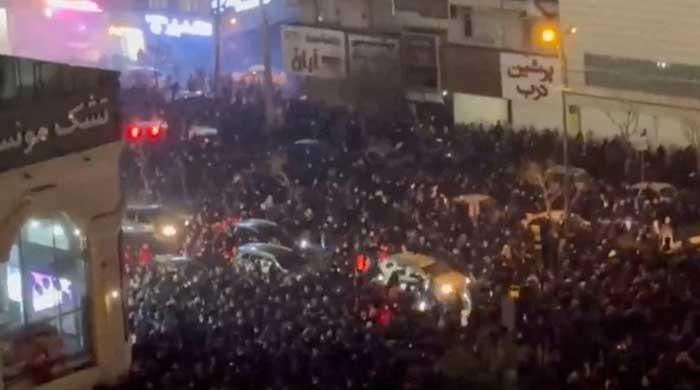
- A rights group reports more than 500 deaths during the two-week unrest.
- The internet outage continues, limiting the flow of information across Iran.
- Iran summons British envoy to Foreign Office following embassy protests.
The Iranian government declared three days of national mourning on Sunday for “martyrs”, including members of the security forces killed during two weeks of protests, state television announced.
The government described the fight against what it called “the riots” as a “battle of Iranian national resistance against America and the Zionist regime,” using the term used by religious leaders for Israel, which the Islamic republic does not recognize.
President Masoud Pezeshkian on Monday urged people to take part in a “national resistance march” consisting of nationwide rallies to denounce the violence, which the government said was carried out by “urban terrorist criminals”, state television reported.
The protests, initially sparked by anger at the rising cost of living, have transformed into a movement against the theocratic system in place in Iran since the 1979 revolution. They have already lasted two weeks.
The protests have become one of the biggest challenges to the power of Supreme Leader Ayatollah Ali Khamenei, 86, in the wake of Israel’s US-backed 12-day war against the Islamic republic in June.
Protests have increased in recent days despite an Internet shutdown that lasted more than 72 hours, according to monitor Netblocks. Activists warned that the shutdown limited the flow of information and that the real toll was likely to be much higher.
Death toll reaches 500: rights group
Unrest in Iran has left more than 500 dead, a human rights group said on Sunday, as Tehran threatened to target US military bases if President Donald Trump followed through on his threats to intervene on behalf of protesters.
As the Islamic Republic’s religious establishment faces the largest protests since 2022, Trump has repeatedly threatened to intervene if force is used against demonstrators.
According to its latest figures – from activists in Iran and abroad – the US-based human rights group HRANA said it had verified the deaths of 490 protesters and 48 members of the security forces, and more than 10,600 people arrested during two weeks of unrest.
Iran has not given an official assessment and Reuters was unable to independently verify tolls.
Trump will meet with his top advisers
Trump was scheduled to meet with senior advisers on Tuesday to discuss options for Iran, a U.S. official said. Reuters on Sunday. THE Wall Street Journal had indicated that options included military strikes, the use of covert cyber weapons, expanding sanctions and providing online assistance to anti-government sources.
The Speaker of the Iranian Parliament, Mohammad Baqer Qalibaf, warned Washington against “a miscalculation”.
“Let us be clear: in the event of an attack on Iran, the occupied territories (Israel) as well as all American bases and ships will be our legitimate target,” said Qalibaf, former commander of Iran’s Revolutionary Guards.
The circulation of information from Iran has been hampered by an Internet shutdown since Thursday.
The unrest in Iran comes as Trump flexes the United States’ muscles internationally, after ousting Venezuelan President Nicolas Maduro and discussing acquiring Greenland by purchase or by force.
Iranian President Pezeshkian said Israel and the United States were behind the destabilization and that Iran’s enemies had brought in “terrorists… who burned mosques… who attacked banks and public properties.”
“Families, I ask you: do not let your young children join the rioters and terrorists who behead people and kill others,” he said in a television interview, adding that the government was ready to listen to the people and solve economic problems.
Iran summoned the British ambassador to the Foreign Office on Sunday over “interventionist comments” attributed to the British foreign secretary and a protester removing the Iranian flag from the London embassy and replacing it with a style of flag used before the 1979 Islamic revolution.
The British Foreign Office did not immediately respond to a request for comment.
Iranian state television broadcast funeral processions in Western cities such as Gachsaran and Yasuj for members of security forces killed during the protests.
State television said 30 members of the security forces were believed to be buried in the central city of Isfahan and that six others were killed by “rioters” in the western city of Kermanshah.


