
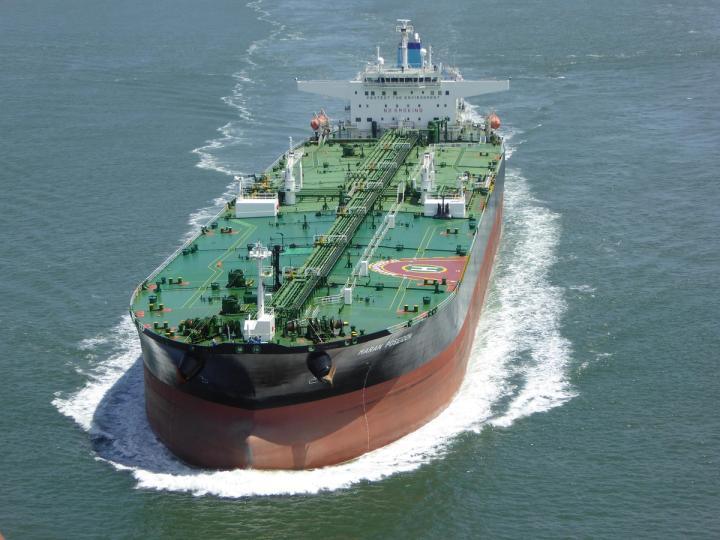
It is no surprise that Iran now accepts cryptocurrency payments from cargo ships transiting the Strait of Hormuz. Blockchain crime experts say the move fits perfectly with Tehran’s existing trade networks that circumvent sanctions.
Iran’s crypto tolls have now been confirmed by recent comments from a spokesperson for the Iranian Oil, Gas and Petrochemical Exporters Union, who said bitcoin was accepted as payment. A previous report suggested that stablecoins were accepted to allow a few selected tankers to pass unscathed. Both reports said the fee was $1 per barrel of oil, with the largest tankers carrying up to two million barrels.
Formalizing a shipping toll payment system made using bitcoin and USD-pegged stablecoins appears to be a bold move. However, in reality, the Iranian regime, and specifically the Islamic Revolutionary Guard Corps (IRGC), has increasingly used cryptocurrency in recent years to facilitate cross-border trade, particularly with Iranian oil sales, according to data from blockchain analytics specialist Chainalysis.
“It’s not at all surprising that this type of exchange is also happening through cryptocurrency,” said Andrew Fierman, head of national security intelligence at Chainalysis, referring to the toll paid by ships allowed to navigate the Strait of Hormuz, a narrow shipping channel where about a fifth of the world’s oil and liquefied natural gas usually passes.
An overview of sanctioned activities over the past year and a half shows a growing and complex network using crypto wallets. In December 2024, a US-sanctioned IRGC-affiliated financier linked to the Iran-backed Houthi regime facilitated sales of Iranian oil to Yemen involving cryptocurrency addresses. This represents more than $178 million in transfers in a single year.
Then, in April 2025, a broader network of Houthi financiers purchased weapons and products from Russia. Their cryptocurrency addresses were included in a sanctions designation representing nearly $1 billion in activity – again roughly over the course of a year.
Interestingly, the Houthis, an Iranian-backed armed group that controls much of northern Yemen, have now raised the possibility of imposing a second chokepoint on the global oil and gas shipping trade, at the Bab-al-Mandeb Canal that connects the Red Sea to the Gulf of Aden.
Either way, the picture is one of IRGC-affiliated networks using crypto on a commercial scale to facilitate cross-border trade, according to Fierman of Chianalysis. It’s a much more complex and established system than just a handful of wallets used in perpetuity, he said.
“They have a network of cryptocurrency wallets that the regime uses to facilitate this cross-border activity. Accepting these cryptocurrency payments would make things easier than potentially using the traditional banking system and there’s enough liquidity that they don’t even need to actually use cryptocurrency exchanges either,” Fierman said in an interview.
The way the IRGC is widely adopting cryptocurrency, particularly stablecoins, as a payment mechanism for cross-border trade is actually the reverse of the situation in North Korea, Fierman pointed out, where the main goal is to steal billions of dollars in crypto and launder it.
The Iranian regime has been under comprehensive sanctions since 1979, including individual sanctions against almost every bank, so its inability to access assets pegged to the U.S. dollar makes international trade difficult.
“The reality is that most counterparties do not want to trade in rials or tomans, especially given the hyperinflation that also occurs regularly in the country. So this ability to obtain an asset pegged to the US dollar creates a mechanism that allows them to trade globally with anyone willing to trade with them, in an alternative mechanism that does not rely on the traditional banking system,” Fierman said.
In Iran, the official currency is the Rial (IRR), but people universally use the Toman on a daily basis in stores, for example; One Toman is equivalent to 10 Rials.
Tom Keatinge, founding director of the Center for Finance and Security (CFS) at British defense think tank RUSI, agreed that dollar-backed stablecoins have become an increasingly important payment mechanism for the Iranian regime as it avoids Western sanctions and banking controls.
“While the use of stablecoins may open users to Western regulatory intervention, evidence suggests this risk is low,” Keatinge said in an email.
Lee Reiners, a lecturer at the Financial Economics Center at Duke University, suggested a new way for the Iranian regime to pursue its stablecoin goals by circumventing sanctions.
“If Iran were thinking strategically, it could take a cue from its strait neighbors in the United Arab Emirates and demand payment in $1,” Reiners said, referring to the stablecoin launched by Trump family-affiliated World Liberty Financial in March 2025. “The president of the United States would then have a financial incentive to lift sanctions and allow them to charge whatever tolls they want.”


