
Drone and rockets hit US embassy in Baghdad; Trump denounces NATO ‘insane’, says US capable of handling crisis alone
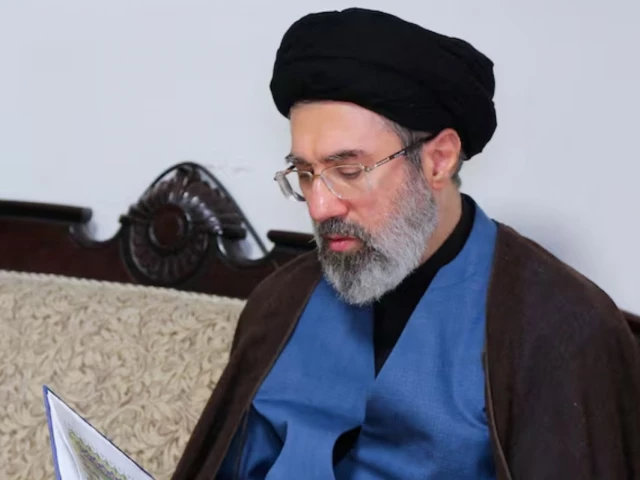
Mojtaba Khamenei, the second son of the late Iranian Supreme Leader Ayatollah Ali Khamenei, visits the Hezbollah office in Tehran, Iran, October 1, 2024. Photo: Reuters/File
DUBAI/JERUSALEM:
Iran on Tuesday rejected proposals to de-escalate the conflict, with Israel saying it had killed Iran’s powerful national security chief in an airstrike, while drone and rocket attacks hit the heavily fortified US embassy in Baghdad, sparking fires in the compound.
With the war in its third week showing no signs of slowing, President Donald Trump has lashed out at “insane” NATO, saying the United States does not need help after its allies rejected his calls to join efforts to reopen the Strait of Hormuz.
A senior Iranian official, speaking anonymously, said the new supreme leader, Mojtaba Khamenei, held his first foreign policy session and rejected foreign offers to reduce tensions or broker a ceasefire.
The official spoke of his determination to continue the resistance “until the United States and Israel are brought to their knees, accept defeat and pay compensation.” He did not specify whether Khamenei attended the session in person or remotely.
Iran has not confirmed claims by Israeli Prime Minister Benjamin Netanyahu and Defense Minister Israel Katz that National Security Council Secretary Ali Larijani was martyred in an airstrike on Tehran.
Israeli strikes targeted the Basij paramilitary force. The Basij, heavily involved in suppressing recent protests, face additional pressure as Israeli forces systematically target their positions in the Iranian capital. Israel claimed that the leader of the Basij force, Gholamreza Soleimani, was also dead.
The IRGC confirmed Soleimani’s death. Larijani, 68, has long played a central role in Iranian strategic diplomacy and military planning. Close to the late Ayatollah Ali Khamenei, he established himself as the regime’s main figure in terms of survival strategy, regional policy and defense coordination.
Despite the war, Iran has mobilized domestic support, calling for nationwide rallies to counter “enemy plots” during celebrations of Nowruz – the Persian New Year. In response, Iranians took to the streets to show solidarity, emphasizing the leaders’ control over domestic affairs.
Meanwhile, air raid sirens sounded across Israel, with explosions heard as far away as Jerusalem. Iranian missiles have so far killed at least 12 people in Israel. The barrage underscores Tehran’s ability to carry out long-range strikes, even after weeks of sustained U.S. and Israeli attacks.
In Iraq, drone and rocket attacks hit the heavily fortified US embassy in Baghdad, triggering explosions and flames near the embassy grounds. Iraqi officials said Iranian-backed groups had carried out several attacks against U.S. interests in Baghdad and the region. Abu Dhabi and Qatar also suffered missile and drone strikes, causing fires and casualties.
The conflict has devastated the Gulf’s energy infrastructure. The port of Fujairah in the United Arab Emirates faced a third attack in four days, disrupting oil loading at the strategic export terminal. UAE authorities said debris from an intercepted missile also killed a Pakistani national in Abu Dhabi.
The Strait of Hormuz, a vital shipping lane through which about 20% of the world’s oil and liquefied natural gas passes, remains effectively closed. Trump called the refusal of Europeans, British and Asians to help reopen the strait a “very stupid mistake.”
Trump said in an article on Truth Social: “Because of the fact that we have had such military success, we no longer ‘need’ or want help from NATO countries – WE NEVER DID!” He stressed that the United States was capable of handling the crisis on its own.
President Trump downplayed the resignation of Joseph Kent, director of the National Counterterrorism Center, calling him “very weak on security” and saying the war was necessary to prevent an imminent Iranian threat to the United States.
Kent resigned in protest of the US-Israeli war. “I cannot, in good conscience, support sending the next generation to fight and die in a war that does not benefit the American people,” he wrote. Kent cited pressure from Israel and its American allies as causing the conflict.
Global energy markets have surged amid the current crisis. Brent crude has risen above $100 a barrel as airlines including SAS, Air France-KLM and Qantas cancel flights to the Middle East or raise prices.
As the Strait of Hormuz remains closed, the International Chamber of Shipping has warned that thousands of seafarers are stuck on ships in the region, facing shortages of fuel, water and supplies.
The human toll of the war continues to rise. Iran has reported more than 1,300 deaths and 7,000 wounded since the start of the conflict. Additionally, regional economic infrastructure also continues to suffer.
The ongoing conflict demonstrates the multi-front nature of the war, with military, economic and humanitarian dimensions spanning Iran, Iraq, Lebanon, Israel and the Gulf. Every day brings new attacks, retaliations and diplomatic tensions, as world leaders struggle to contain the crisis.
European Union officials have advocated diplomatic solutions to the crisis. Kaja Kallas, EU foreign policy chief, said it was essential to prevent food, fertilizer and energy crises by keeping transport channels open.


