
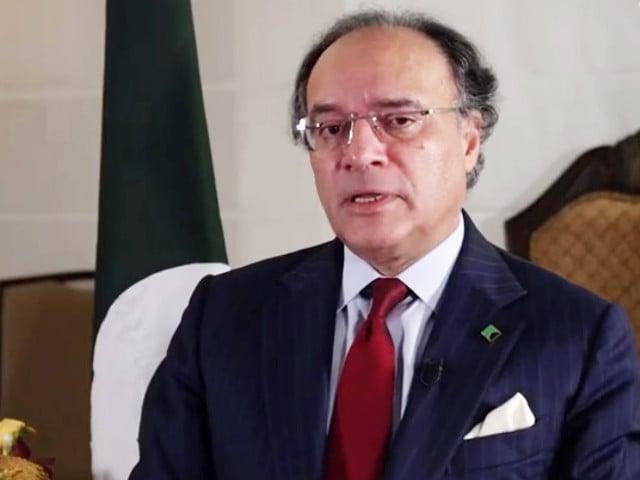
The Federal Minister of Finance, Senator Muhammad Aurangzeb, said on Saturday that Pakistan information technologies (TI) and mineral sectors have a transformer potential for the national economy.
He stressed that these sectors would change the game in the coming years, adding that under the direction of Prime Minister Shahbaz Sharif, the country’s economic management has become clearer, with positive results expected soon.
Addressing the business world of the Lahore Chamber of Commerce and Industry (LCCI), the Minister of Finance underlined the government’s commitment to listen to and resolve the challenges of the private sector.
“We are here to serve people. I visit rooms to listen, understand and solve the problems of the business world. The legitimate requests for the chambers will be accepted, “he said.
Aurangzeb cited Singapore’s success with Nickel exports – by reducing USD 22 billion – and has led to parallels with copper reserves in Pakistan, highlighting the large potential in the mineral sector. He also noted an increase in world interest in IT and Pakistani minerals and reiterated the government’s determination to eliminate obstacles from local and foreign investors.
On economic stability, the Minister of Finance underlined the improvement of macroeconomic indicators, declaring:
“Inflation reduction is essential for economic stability. The interest rate was 22%today, it is 12%. ”
He stressed the importance of reducing financing costs, power prices and implementing improved tax policies to stimulate industrial growth.
Aurangzeb also said that restrictions on the repatriation of profits for foreign investors had been lifted, restoring the confidence of investors.
“We make sure that the advantages of reduced inflation directly reach ordinary man. Intermediaries will not be allowed to exploit the system,” he promised.
Radifying the tax challenges, the minister recognized the burden of the salaried class:
“Income tax is deducted from the source, and we intend to offer relief to the employee segment.”
He revealed that 24 national entities had been intended for privatization and called to minimize human interaction in the system to reduce ineffectures.
“If we can increase the 13%tax ratio / GDP, we can offer wider alleviation to various sectors,” he said, noting that the drop in edible prices had limited opportunities for intermediaries to exploit the system.
During the question / answer session, Aurangzeb confirmed that visa problems were regularly discussed during meetings during the Prime Minister’s foreign visits and were discussed in priority.
He reaffirmed the government’s commitment to engage with the private sector:
“The private sector plays a key role in managing any country. A committee was trained, according to the management of the Prime Minister, who works on GSP Plus. ”
The president of the LCCI, Mian Abuzar, praised the steps of the government towards economic renewal.
“We appreciate the reduction in the policy rate by 22% in June 2023 to 12% now.
He also praised the launch of the “Uraan Pakistan” program, aimed at stimulating exports to $ 60 billion, attracting $ 10 billion in annual private investment, creating one million jobs per year and tackling the objectives of climate and energy. He highlighted the special role of the investment facilitation council (SIFC) in improving the confidence of investors.
The vice-president director of the LCCI, the engineer Khalid Usman, recommended to increase the rolling threshold for the restraint of agents of RS. 100 million to Rs. 250 million. He expressed his concern about the freezing by the FBR of bank accounts in the light of legal affairs pending on the value of capital value (CVT) within the framework of the amnesty regime, qualifying unjustified practice.
Vice-president Shahid Nazir Chaudhry called for long-term economic planning, suggesting a 10-year political roadmap. He proposed tax deductions on R&D expenses by private companies to promote innovation and technological development.
The vice-president of the Saarc Chamber Mian Anjum Nisar echoes the need for economic growth focused on innovation.
The session was followed by representatives of the Federal Board of Return (FBR), business leaders and members of various chambers.


