
Judges who have highlighted agency interference in the justice system continue to face difficult times
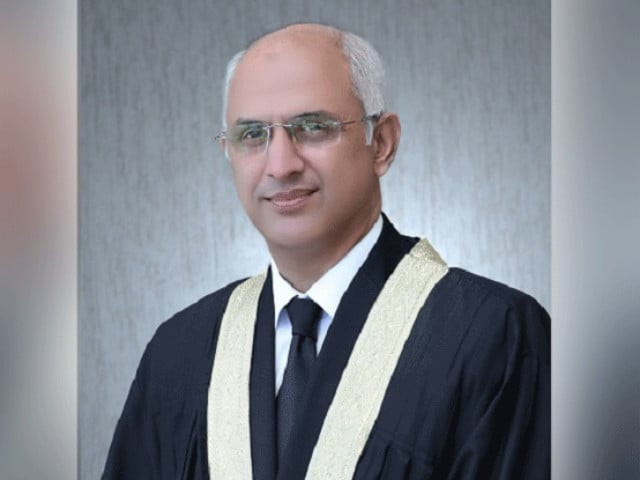
Justice Mohsin Akhtar Kayani of the Islamabad High Court (IHC). PHOTO: FILE
ISLAMABAD:
Once again, the Judicial Commission of Pakistan (JCP) has neglected Islamabad High Court (IHC) Senior Puisne Judge Mohsin Akhtar Kayani while filling vacancies in the Supreme Court.
At its meeting on Tuesday, only one member of the JCP, Justice Munib Akhtar, voted in favor of Kayani’s elevation to the SC. No other judicial member of the commission, Chief Justice of Pakistan (CJP) Yahya Afridi, Federal Constitutional Court Chief Justice Amin-ud-Din Khan and Justice Hasan Azhar Rizvi supported the proposal.
There is no justification for not elevating Justice Kayani to the highest court.
Meanwhile, it has been proposed that Justice Miangul Hassan Aurangzeb, who is already working as an acting SC judge, be appointed as a permanent SC judge.
Previously, CJP Afridi was interested in appointing Aurangzeb as the IHC chief justice, but the majority of JCP members, especially those belonging to the executive, did not agree with this idea. Instead, they voted for the appointment of Justice Sardar Muhammad Sarfraz Dogar as the chief justice of the IHC.
Justice Dogar was one of three judges transferred to the IHC from other high courts in February.
A senior lawyer said Justice Miangul Hassan Augranzeb is an image-conscious judge and that is the reason the government did not support his nomination as IHC Chief Justice.
The executive gained a dominant position within the JCP after the adoption of the 26th Amendment.
JCP judicial members have also been unable to develop a strategy to reduce this dominant executive role within the commission.
Earlier, the JCP failed to approve by majority a proposal to appoint Justice Muhammad Kamran Khan Mulakhail as the Chief Justice of the Balochistan High Court (BHC).
However, the commission on Tuesday unanimously approved his nomination as chief justice of the BHC.
There is no justification as to why he was ignored then and elevated to the same position this time. Interestingly, members of the judiciary have also changed their position towards him.
The five IHC judges who wrote a letter last year against the alleged interference of intelligence agencies in judicial functions are going through a difficult time. They also failed to gain support from their fellow judges.
Firstly, the chief justices of the high courts, along with CJP Yahya Afridi, approved the transfer of three judges from different high courts to the IHC. Since these transfers, the five judges, notably Judge Kayani, have been sidelined. The judges also approached the SC, but their grievances could not be redressed.
After the passage of the 27th Constitutional Amendment, these judges have limited space.
After the resignation of Justice Syed Mansoor Ali Shah and Justice Athar Minallah from the Supreme Court, reports indicated that some IHC judges may also resign. However, they resisted and challenged the 27th constitutional amendment in the Supreme Court.
Likewise, they also challenged the constitutionality of the Federal Constitutional Court (FCC) in the case of transfer of judges. Their intra-judicial appeal was dismissed by the FCC for non-prosecution.
Efforts are now being made to force Judge Tariq Mahmood Jahangiri to resign.
A division bench of the IHC headed by Justice Sardar Muhammad Sarfraz Dogar, while ignoring an order of a larger bench of the SC, sought the record of the Higher Education Commission (HEC) regarding the degree of Justice Jahangiri.
Earlier, the judiciary headed by Justice Dogar had stopped Justice Jagangiri from carrying out his judicial work. The interim order had been set aside by the SC. The SC expected the IHC division bench to first decide whether to maintain the quo warranto petition against Justice Jahangiri.
However, instead of deciding the objections, the IHC bench sought the HEC file on Tuesday. Even no notice was issued to the respondent judge.
Several questions need to be addressed in this case.
Firstly, the same case is already pending before the Sindh High Court. Likewise, it is necessary to first determine the appropriate forum. Some judges have already expressed the view that only the Supreme Judicial Council (SHC) can prosecute a judge and no other body can remove a judge.
The same case is also pending in the Sindh High Court. The IHC ignored this aspect and decided to pursue the case.
It is also necessary to decide whether Justice Dogar can hear Justice Jahangiri’s case as Justice Jahangiri was among the five judges who challenged Justice Dogar’s transfer to the IHC. Earlier, Justice Jahangiri had also raised the issue of bias in this case.
It is true that relations between the five IHC judges and the executive are not cordial, but their own fellow judges are giving them a hard time.


