
Gul Plaza fire highlights weak oversight, limited resources and paper safety culture
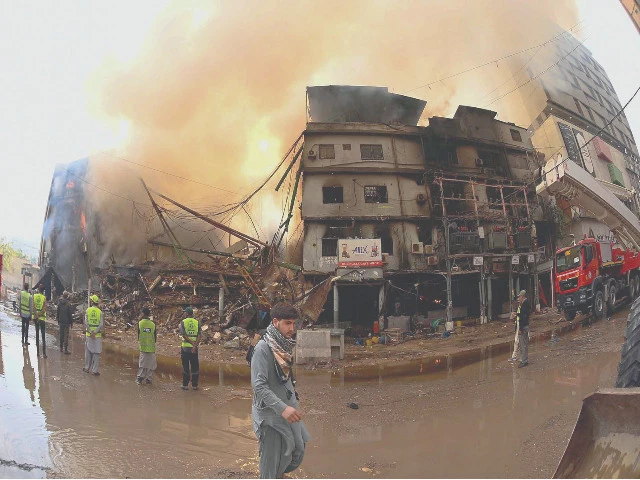
Smoke billows from Karachi’s Gul Plaza following a massive fire. Photo: INP
KARACHI:
About 80 people are still missing and at least 26 have been confirmed dead after a devastating fire ripped through the Gul Plaza shopping center, destroying the building and trapping dozens of people inside. The fire raged for more than 36 hours before being brought under control, as heavy smoke, repeated water shortages and limited equipment slowed rescue efforts.
Shop owners estimate losses at billions of rupees, wiping out years of investment in a matter of hours. Many traders described scenes of chaos and despair, accusing relief officials and the Sindh government of a delayed and inadequate response. Eyewitnesses and concerned shopkeepers said the firefighters arrived late, the firefighters lacked proper machinery, and the rescuers did not have protective masks, preventing them from entering the building in the critical early hours. Several said water flowed out multiple times, forcing operations to stop and allowing the fire to intensify and become a third-degree fire.
The Gul Plaza tragedy has once again exposed chronic fire safety failures in Karachi – problems that extend far beyond a single building and speak to a deeper institutional breakdown in the city’s commercial and industrial areas.
“There is no proper system in place,” said a former director general of the Export Processing Zone (EPZ). The Express PK Press Clubcommenting on the recurring fires in the industrial zone. He said the area lacks both effective internal security mechanisms and meaningful external oversight, creating conditions where disasters are almost inevitable.
Even a quick online search of the EPZ paints a worrying picture, with headlines dominated by fires rather than industrial production or export growth. Former EPZ Managing Director AD Khawaja, who is also the former IGP Sindh, said the causes are neither isolated nor accidental, but rooted in systemic failures, ranging from daily operations of the factory to absence of basic fire safety infrastructure. “This is not a mistake or a factory,” he said. “This is a system that is failing on every level.”
The Landhi EPZ was established as a cornerstone of Pakistan’s export strategy, offering duty-free imports, tax exemptions and simplified rules to attract investment in sectors such as IT, garments and engineering. Investors were promised modern infrastructure and regulatory support, but these assurances were increasingly undermined by weak enforcement of safety standards.
Learn more: Gul Plaza fire brought under control after 36 hours; 14 dead in emptied Karachi shopping mall
Khawaja highlighted the lack of continuity in leadership as a major factor. “There is no continuity in management,” he said, pointing out that most ZFE presidents operate from Islamabad, far from ground realities. “That disconnect is part of the problem.”
Fire Chief Humayun Khan said the EPZ management’s failure to adhere to the established memorandum of understanding and safety protocols was a critical issue.
The results are visible. Three major fires have broken out in the EPZ in the past year alone. Preventive measures remain weak, while firefighter access is often blocked. Khan highlighted the danger of basement fires: Without standard operating procedures or proper entry points, firefighters cannot reach the source, allowing flames to spread unchecked.
Karachi’s broader fire response system is equally fragile. A recurring detail in fire reports is the arrival of two snorkels during major incidents. In fact, the city of more than 35 million inhabitants only has two tubas in total. Moving them long distances costs valuable time, allowing fires to intensify before any significant action begins.
Official data reflects the scale of the crisis. In 2025, Karachi recorded over 2,400 fire incidents, causing property losses worth millions of rupees. Firefighters say many lives and livelihoods could have been saved with a functional, well-equipped system.
Learn more: Fire breaks out at garment factory in Karachi Export Processing Zone
Khawaja said the EPZ does not have its own dedicated firefighting team. Internal security systems often fail to activate quickly, while delays in external responses allow fires to spread, creating a dangerous cycle of institutional inefficiency.
The physical configuration of the area adds to the risk. The factories are clustered together, most rising five stories high on plots as small as 6,000 square meters. “Once a fire breaks out, containment becomes extremely difficult,” Khawaja said.
Former fire chief Mubeen Ahmed said conditions were not always this bad. “Thirty years ago the system was much better and such incidents were rare,” he said. The Express PK Press Club. “Over time, management expanded the area, stacked factories on top of each other and abandoned inspections. That’s when the risks multiplied.”
Another former fire chief, Zafar Mairaj, said the EPZ, although under the federal government, collects taxes from factories and is responsible for ensuring fire safety. Although the area has its own fire station, he said it was understaffed, lacked tenders and could not respond effectively, forcing the Karachi Metropolitan Corporation to intervene. He wondered why the EPZ continues to “fail to fulfill these responsibilities even though it has assumed them”.
Most fires in the area start in textile and garment factories, where highly flammable materials allow flames to spread within minutes. The frequency of such incidents means that they hardly make headlines, but together they reveal a deeper institutional failure.
The fact that Karachi’s largest industrial hub – a key driver of the city’s economy and national exports – lacks basic fire safety underscores a grim reality: the city that runs the country lacks the systems needed to protect itself.
With just 28 fire stations serving more than 35 million people, authorities warn that without a major overhaul of fire safety infrastructure, stricter enforcement of building regulations and responsible local management, tragedies like that at Gul Plaza will continue – at an ever-increasing human and economic cost.


