WASHINGTON: International markets and the world at large have become accustomed to sudden U-turns from US President Donald Trump, but Monday’s about-face on Iran was one of the most dramatic yet.
Since returning to power last year, Trump has openly embraced the principle of governing “by instinct.”
On the Middle East conflict, he made a series of contradictory statements on goals and timetable, and even declared on March 13 that the war would end when he “felt it in his bones.”
“Trump is a master of abrupt changes, so sometimes it’s hard to know if there’s a strategy or if it’s always improvisation,” said Garret Martin, professor of international relations at American University in Washington.
These reversals usually follow a pattern. The Republican president launches commercial, diplomatic or military threats, often accompanied by ultimatums, which stun the international community.
Then he suddenly changes course. He claims to have obtained decisive concessions which he rarely discloses and promises a resolution to the crisis, causing spectacular market fluctuations.
On Monday, oil prices fell and stocks jumped after Trump announced on his Truth Social platform that the United States had held negotiations with Iran to end the conflict. North Sea Brent crude fell more than 14 percent while its U.S. equivalent, West Texas Intermediate, lost almost 10 percent. The Dow Jones Industrial Average, meanwhile, jumped 700 points.
Tacos
As recently as Saturday, Trump gave Iran 48 hours to reopen the Strait of Hormuz – a vital passage for oil shipments from the Gulf – under threat of massive strikes on the country’s power plants. He didn’t talk about dialogue.
But on Monday, he set a new deadline – five days this time – to allow time for negotiations to continue.
He spoke of “very productive” discussions with “very respected” and “very solid” Iranian officials, without identifying them.
But Iranian officials have denied any negotiations are taking place, which has partially dampened market enthusiasm.
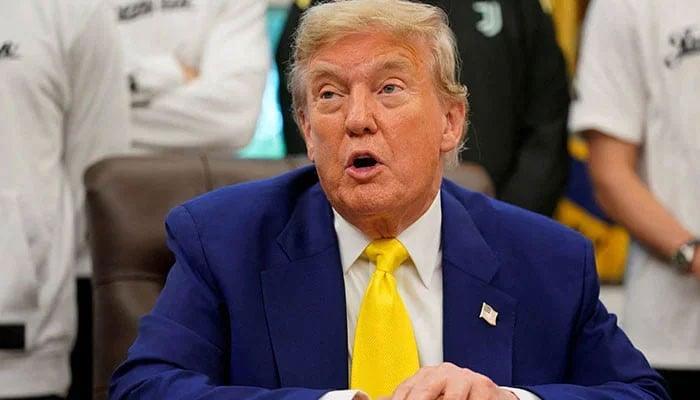
Trump boasted of his negotiating skills in a speech Monday in Memphis, Tennessee, emphasizing his business instincts over specific concessions from Tehran.
“My whole life has been a negotiation, but with Iran we have been negotiating for a long time,” he said. “And this time, they’re serious.”
This model is so familiar that it has its own acronym – “TACO” for “Trump Always Chickens Out” – coined by Financial Times journalist Robert Armstrong in May 2025 after Trump backed away from his threats to impose global tariffs that wreaked havoc on the market.
Shake up the markets
The term TACO originally referred to a stock market strategy of capitalizing on a decline in assets — triggered by a bombastic announcement by Trump — to buy low, in the hopes of reselling at a profit once he inevitably changes his mind.
Other examples include Trump walking away from threats of a US takeover of Greenland, or those directed at Federal Reserve Chairman Jerome Powell over US interest rates.
Often, even though these reversals shake up markets, they remain unclear in terms of actual transactions.
Both partners and adversaries of the United States now know “that there is always an impermanence in everything with this administration; agreements and promises are only as good as they are made,” Martin said.
In the case of Iran, Martin suggests that Trump backed down due to three factors: market nervousness, potential pressure from Gulf countries, and the emergence of “tensions” within his own Make America Great Again, or MAGA, political movement over the conflict.