
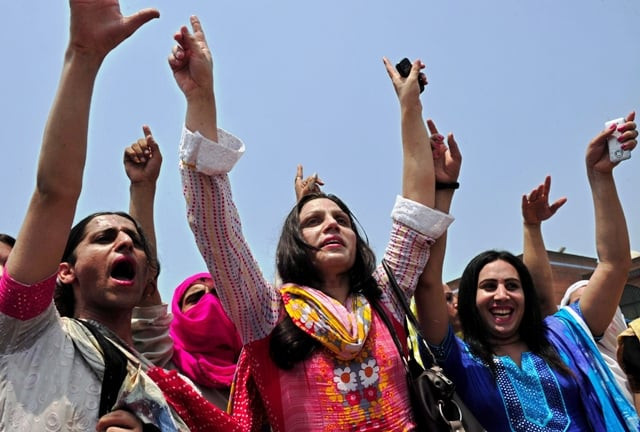
The plan builds on the Transgender Persons (Protection of Rights) Act 2018, adding a welfare fund, shelters, jobs and protection.
PESHAWAR:
In an important step towards tackling long-standing marginalization, the Khyber-Pakhtunkhwa government has introduced a new comprehensive policy aimed at protecting transgender people, commonly known as Khawaja Sira in the region, from harassment, violence and discrimination while promoting their welfare, rights and economic independence.
The policy, rolled out recently, marks a renewed commitment to transgender inclusion, building on federal protections under the Transgender Persons (Protection of Rights) Act, 2018. Despite constitutional guarantees, transgender people in Pakistan, including KP, continue to face severe exploitation in education, healthcare, employment and access to justice. The new framework aims to address these gaps through targeted interventions across multiple sectors.
The cornerstone of this policy is the creation of the province’s first endowment fund dedicated to transgender well-being. This fund will provide sustainable financial resources to support economic empowerment, skills development and long-term rehabilitation efforts.
To provide immediate protection and support, the policy mandates the establishment of rehabilitation centers, safe homes and community shelters specifically for transgender people. These facilities will provide safe living environments and assistance to people facing violence or displacement.
Administrative reforms include the mandatory creation of a transgender protection register and a comprehensive database. This centralized system will facilitate access to provincial and national social protection programs, subsidies, health insurance schemes (such as the Sehat Card), skills development initiatives and emergency response measures.
The Department of Social Welfare has been designated as the focal department responsible for the welfare and protection of transgender people. It will develop policy frameworks, monitor integration into public services, coordinate with other ministries and ensure compliance across the province.
District level coordination committees will be formed to resolve local issues. In the justice and law enforcement sector, dedicated cells in prisons and detention centers, as well as “transgender coordination offices” at the district police officer level in each district, will serve as the main points of contact for reporting harassment, violence or seeking protection.
Under the Khyber-Pakhtunkhwa Police Act, 2017, transgender representatives will be included in dispute resolution boards at district and tehsil levels. The policy also calls for gender-sensitive rehabilitation for transgender people on probation, recruitment opportunities into the police force, and the inclusion of modules on transgender rights and recognition in police training programs and academies.
Other departments have been assigned roles: The Department of Transportation will train drivers and chauffeurs on transgender rights through certified programs. The Ministry of Health must ensure inclusion in all public hospitals, providing hormone therapy, mental health services, HIV/AIDS care and dedicated monitoring.
In education, the policy mandates nondiscriminatory admissions, teacher training, enrollment based on self-identified name and gender, quotas in higher education, separate hostels, and scholarships. The Ministry of Labor is responsible for ensuring equal wages, employment opportunities, TVET allowances and partnerships with the private sector.
Mandatory training and awareness campaigns for civil servants, as well as dedicated budget allocations and donor collaboration, will support implementation. Standard Operating Procedures (SOPs) will address grievances, training needs and inclusion in core services.
Sources note that this echoes earlier efforts of the PTI government’s first term in 2018, when a similar policy was announced, including promises of residential facilities, education, health services and an initial allocation of Rs 20 million for economic self-reliance. However, these initiatives have largely remained a dead letter.
Currently, the Department of Social Welfare has registered around 600 transgender people in the province, although NADRA records show around 170. New standardized registration forms have been distributed to all districts, with district welfare officers instructed to compile and transmit the data as soon as possible.
This policy represents a proactive shift from simple protection to active empowerment and inclusion. If implemented effectively, it could significantly improve the lives of transgender people in KP, setting a model for other provinces amid persistent societal stigma and institutional barriers.


