
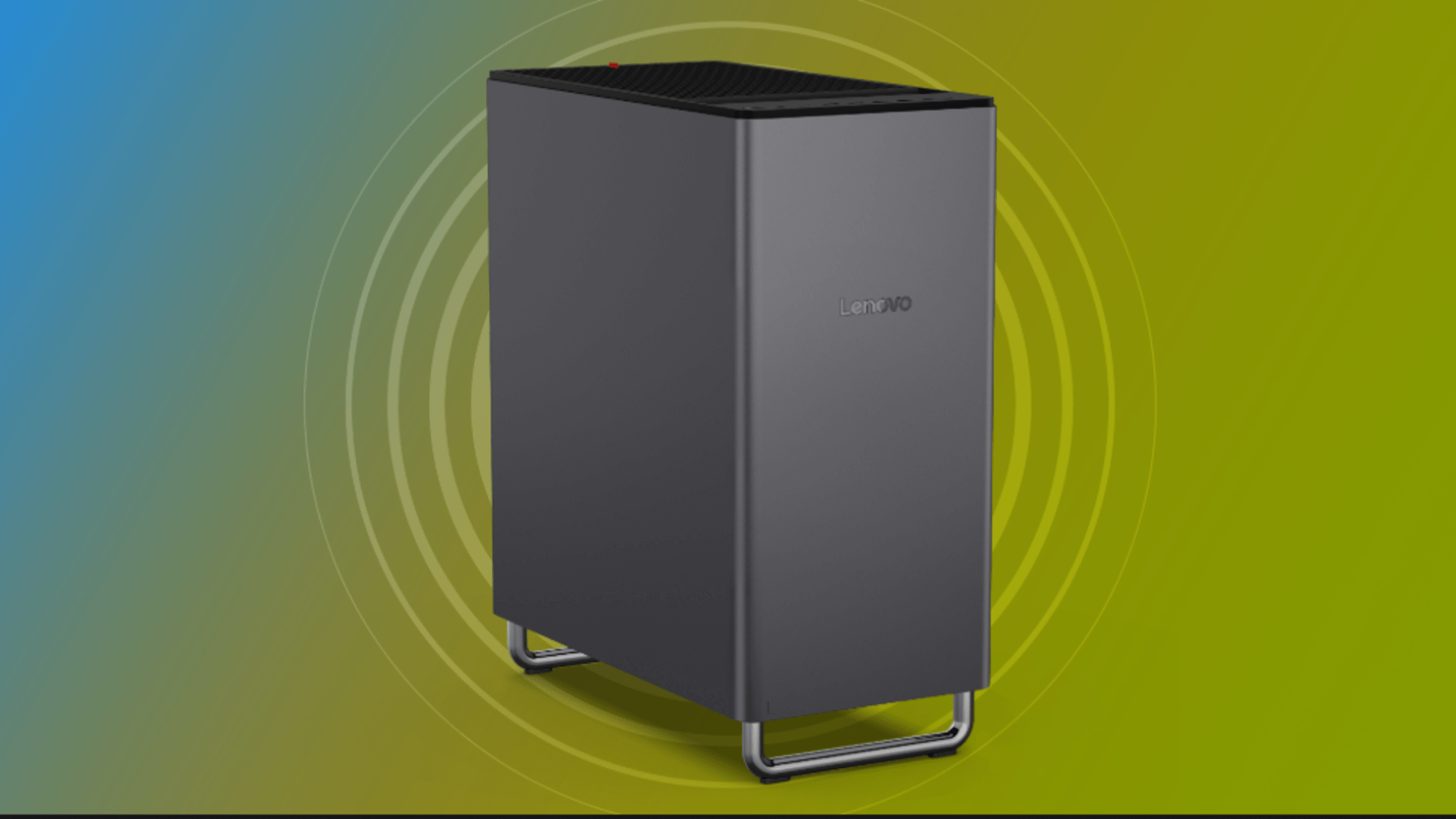
- Lenovo ThinkCentre X Tower 1TB AI Fusion card enables local post-training for massive models
- Dual RTX 5060 Ti cards provide 32GB of VRAM for extended context lengths
- Intel Core Ultra 9 processor and 256 GB memory avoid preprocessing bottlenecks
At CES 2026, Lenovo revealed the ThinkCentre X Tower, its latest workstation-class desktop designed for AI inference and data-intensive computing.
The device supports either a single high-end Nvidia GeForce RTX 5090 with 32GB of memory or a dual RTX 5060 Ti configuration.
It marks a return to an SLI-style multi-GPU approach, a configuration that became viable around 2010 when driver support improved and scaling of both cards reached 60-80% in real-world applications.
Dual GPUs Return for Modern Inference Workloads
Rather than focusing on raw frame rates, the dual RTX 5060 Ti configuration emphasizes memory capacity by combining 32GB of GDDR7 VRAM across both cards.
This capability allows large language models to run locally with extended context lengths that exceed what many single-board systems can support.
However, setting up two RTX 5060 Ti cards requires careful system planning, including enough PCIe slots, strong airflow, and a capable power supply.
The ThinkCentre X Tower uses an Intel Core Ultra 9 processor and supports up to 4 x 64 GB of DDR5 6400 UDIMM memory.
This design prevents CPU-side preprocessing and memory-intensive tasks from becoming immediate bottlenecks during inference operations.
Expansion options remain extensive, with multiple PCIe slots, up to 3 x 2TB M.2 PCIe 2280 SSD storage bays, and legacy connectivity options.
The system also includes 1x Thunderbolt 4, 1x USB-C, 6x USB-A, 2x Ethernet, 1x HDMI 2.1, 1x DisplayPort 1.4a, audio in and out, and optional PS/2 or COM ports.
In hands-on testing, the dual-GPU setup pushes Mixture-of-Experts models like Qwen3-MoE 30B past 100,000 tokens.
It reliably supports around 131,000 tokens, while dense models such as the Qwen3 32B reach up to 45,000 tokens.
FlashAttention improves responsiveness and reduces chatter during high-context inference tasks.
Optimized runtimes like ExLlamaV3 and TabbyAPI help close performance gaps, making the system more responsive even with context lengths of 32,000 to 44,000.
However, stability under sustained inference loads emerges as the primary benefit rather than true throughput leadership.
Token generation performance also remains constrained by bandwidth limitations, particularly as context sizes increase.
Beyond the GPU selection, Lenovo includes support for a 1TB AI Fusion card, which remains one of the less clearly defined elements of the system.
This component allows local post-training and fine-tuning for models with up to 70 billion parameters.
Cooling these workloads relies on a biomimetic fan design in a 34-liter chassis, which supports high airflow for dual-GPU configurations.
Lenovo also includes support for a Sensor Hub assistant that integrates cameras, microphones, radars, and environmental sensors.
The system processes data locally to adjust performance characteristics, privacy behavior, and energy efficiency in real time.
Although such adaptive systems promise efficiency gains, their actual value will likely depend on the maturity of the software and the transparency of user control.
Security features include DTPM 2.0, ThinkShield, Kensington security slot, optional chassis intrusion switch, electronic lock, and smart cable lock.
Weighing over 20kg, the ThinkCentre X Tower prioritizes modularity and airflow over physical convenience.
The dual RTX 5060 Ti configuration is especially great for users who need large pop-ups and model flexibility.
The device starts at $1,500 and will be available in March 2026, while the Sensor Hub costs an additional $99 and will be available in June 2026.
TechRadar will cover this year’s events extensively THESEand will bring you all the big announcements as they happen. Visit our CES 2026 News for the latest stories and our hands-on verdicts on everything from wireless TVs and foldable displays to new phones, laptops, smart home gadgets and the latest in AI. You can also ask us a question about the show in our Live Q&A from CES 2026 and we will do our best to answer them.
And don’t forget to follow us on TikTok And WhatsApp for the latest news from the CES show!


