
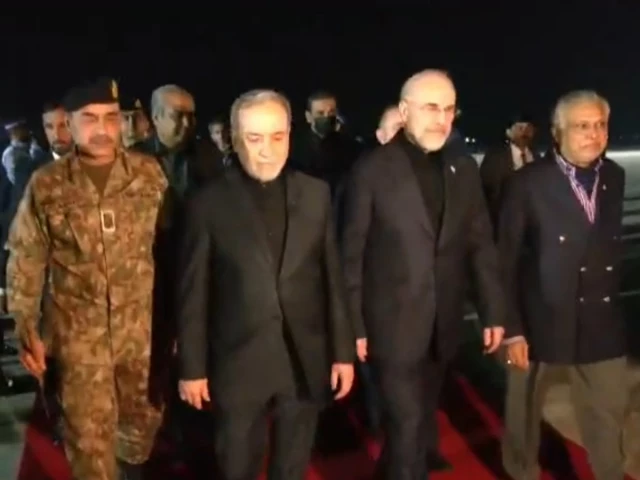
Iranian delegation led by President Ghalibaf lands in Islamabad, en route to meeting US Vice President Vance
Pakistani leaders are hosting the Iranian delegation for talks with the United States in Islamabad on Friday evening. – SCREENSHOT
ISLAMABAD:
As top officials from the United States and Iran prepare to hold historic talks in Islamabad on Saturday, Prime Minister Shehbaz Sharif called the high-stakes negotiations a “watershed moment” for peace.
Despite previous uncertainty and competing claims over the terms of the ceasefire, negotiations are continuing as planned amid an unprecedented security lockdown in the federal capital.
Iranian Foreign Minister Abbas Araghchi and Parliament Speaker Mohammad-Bagher Ghalibaf landed in Pakistan on Friday evening, the Foreign Ministry said.
The delegation was received by Deputy Prime Minister/Foreign Minister Ishaq Dar, Speaker National Assembly Sardar Ayaz Sadiq, Chief of Defense Forces and Chief of Army Staff Field Marshal Syed Asim Munir and Interior Minister Syed Mohsin Raza Naqvi, the statement added.
Iran’s Tasnim news agency reported that Ghalibaf led the delegation, which includes FM Araghchi, Secretary of the Defense Council Ali Akbar Ahmadian, Central Bank chief Abdolnaser Hemmati and some members of Parliament.
Prime Minister Shehbaz Sharif addressed the nation in a televised address, describing the upcoming talks as a “watershed moment” for peace.
“I ask you all to pray that these talks will be successful and that countless lives will be saved and that the world will experience peace,” the Prime Minister said, emphasizing the gravity of the situation and Pakistan’s mediating role at a critical time.
Pakistan has been working behind the scenes for weeks to bring the two sides to the negotiating table.
Officials familiar with diplomatic efforts say Islamabad has leveraged its ties with Washington as well as its indirect contacts with Tehran to create conditions conducive to dialogue.
In his speech, Shehbaz singled out Field Marshal Asim Munir and Foreign Minister Ishaq Dar for their role in defusing tensions and facilitating engagement between the two adversaries.
He credited them with helping to “extinguish the flames of war,” a public recognition of civil-military coordination in sensitive diplomatic initiatives.
The talks will officially begin on Saturday, with the arrival of the two delegations under tight security in Islamabad.
The capital has seen heightened security measures over the past 48 hours, with limited travel in key areas and an increased law enforcement presence, reflecting the high-profile nature of the visit.
From the United States, Vice President JD Vance leads the delegation.
Speaking before leaving for Pakistan, Vance struck a cautiously optimistic tone, saying Washington was open to dialogue if Iran showed sincerity.
“If the Iranians are willing to negotiate in good faith, we are certainly willing to extend a hand,” he told reporters, echoing a broader U.S. position that leaves the door open for diplomacy while maintaining pressure.
However, the message sent by Washington is far from uniform. President Donald Trump has paired his calls for negotiations with stark warnings about resuming military action if talks fail.
In an interview with an American media outlet, Trump said the United States was prepared for escalation if necessary.
“We will know in about 24 hours. We will know soon,” he said, adding that Washington had already started preparing a possible military response.
Trump also expressed skepticism about Iran’s intentions, suggesting that mixed signals from Tehran raised doubts about its willingness to compromise, particularly on the contentious issue of nuclear enrichment.
On the Iranian side, expectations are tempered by clear preconditions.
Parliament Speaker Mohammad Bagher Ghalibaf publicly stated that negotiations could only take place if certain demands were met, including a ceasefire in Lebanon and the release of Iran’s frozen financial assets.
Diplomatic observers note that both sides appear to be hardening their positions in terms of tactics and public posture.
Still, analysts say even a preliminary engagement would be a significant step forward given the current level of hostility.
For Pakistan, hosting these talks represents both an opportunity and a challenge.
Islamabad has long sought to position itself as a credible mediator in regional and global conflicts, and success in these negotiations could significantly improve its diplomatic standing.
At the same time, failure could reveal the limits of its influence and underscore the deep distrust that continues to define the U.S.-Iran relationship.
The authorities remain cautious and do not wish to disclose any details. An unprecedented level of secrecy surrounded the negotiations.
The Prime Minister, for his part, declared in his speech that Pakistan “will ensure that these negotiations succeed by doing its best”, while recognizing that the final outcome remains uncertain.


