
Former SC judge Mansoor Ali Shah argues for promoting alternative dispute resolution
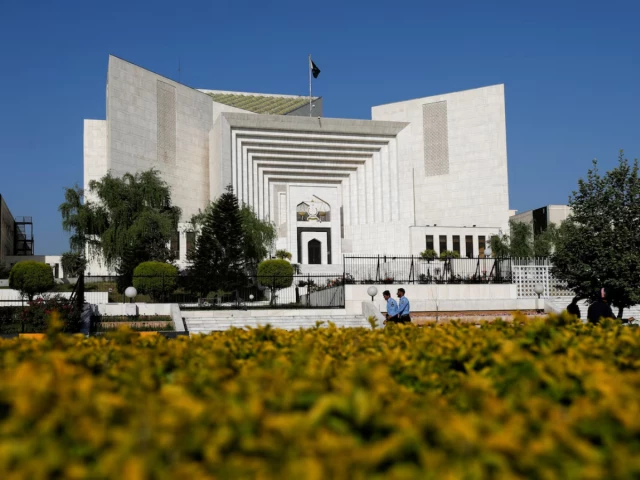
Police officers walk past the Supreme Court of Pakistan building, in Islamabad, Pakistan April 6, 2022. REUTERS
LAHORE:
Former Supreme Court judge Syed Mansoor Ali Shah on Saturday highlighted the importance of alternative dispute resolution (ADR), terming it the “future of Pakistan’s judiciary” and a viable solution to the growing backlog of cases in the country.
Addressing a conference on ADR, Justice Shah said ADR is in fact an older and more traditional system than formal courts, rooted in community-level dispute resolution.
“Before the formal justice system, conflicts were resolved through reconciliation and community mechanisms, but over time this culture has faded,” he observed.
Highlighting the scale of the challenge, he noted that more than two million cases are currently pending in Pakistani courts. “If ADR is effectively implemented and encouraged, a significant portion of these cases can be resolved outside of court,” he said. He said thousands of cases, especially those related to family and property matters, do not necessarily require trial and could be resolved through mediation centers.
“Not all disputes need to be brought to court. Many can and should be resolved through dialogue and reconciliation,” he added. Justice Shah stressed the need to change society’s attitudes towards conflict.
“We must develop a culture in which dialogue, not conflict, is seen as the primary solution. Litigation should be the last resort and not the first,” he said.
He added that in some cultures, notably China, a court case is seen as a failure of relationships, and efforts are made to resolve disputes without resorting to the courts. He also criticized the growing trend of seeking stays of proceedings in individual cases, calling for an end to such practices. “The state should make it obligatory to attempt reconciliation before any dispute,” he suggested.
Referring to the role of legal professionals, he said lawyers also have a responsibility to promote alternative dispute resolution mechanisms rather than encouraging protracted litigation for financial gain. “We need to abandon the mentality that more cases mean more revenue,” he said.
Justice Shah noted that Pakistan has around 3,000 judges for a population of 250 million, making it impossible for courts to handle the growing caseload on their own. “As many cases are decided, so many new ones are filed,” he said, emphasizing the need for systemic change.
Drawing on religious and cultural references, he said Islam promotes reconciliation and the peaceful resolution of disputes. “Our Holy Prophet (PBUH) set an example of resolving conflicts through dialogue and mediation,” he added.
Sharing his experience, Justice Shah said that during his tenure, ADR centers were established in every district and judges were trained to prioritize reconciliation. “The judges were instructed to first attempt mediation before proceeding with a formal trial,” he said.
He emphasized that behind every case are real human stories – of families, children and livelihoods – and that effectively resolving disputes through ADR would not only ease the burden on the courts but also enhance social harmony.


