
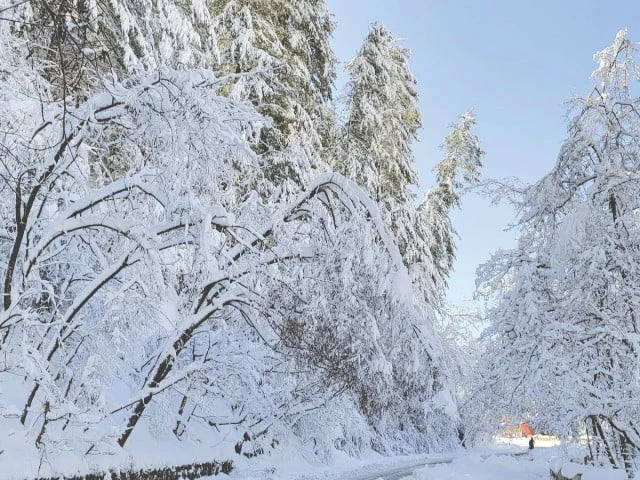
A man walks on a snowy road in Abbotabad. Photo: PPI
ISLAMABAD:
Pakistan is grappling with harsh winter conditions as heavy snowfall and rains continue to disrupt life in the northern, northwest and hill regions – from the Tirah Valley to Murree, Kotli, Nakyal and Galiyat.
In the high-altitude districts of Balochistan and Azad Kashmir, residents, tourists and authorities are facing extreme challenges, necessitating large-scale relief efforts and urgent warnings from weather and disaster management authorities.
Pakistan Army has been at the forefront of relief operations, carrying out prompt and professional rescue and relief initiatives in Tirah, Kotli, Nakyal, Jandrott, Pir Nasoorah and other affected areas.
Life in Tirah, in particular, has been paralyzed due to heavy snow, with vehicles stranded and communication lines disrupted. Army teams, alongside the Frontier Corps, safely evacuated stranded families, restored major roads and provided essential items including food, blankets, winter kits, emergency medical aid and even gasoline for vehicles stranded by snow.
The Kotli-Nakyal road, crucial for regional connectivity, was fully reopened to traffic following these operations. Officials noted that despite adverse weather conditions and logistical difficulties, rescue teams remained on the ground, personally supervising the distribution of supplies and the evacuation of stranded citizens.
In a remarkable display of operational capability, the Army also conducted a helicopter rescue mission in Leepa Valley of Azad Kashmir. Following heavy snowfall which cut off all ground communications, a patient was airlifted safely to Rawalpindi Military Hospital.
The rescue mission highlighted meticulous coordination at every stage, from helipad preparation to route restoration and timely air transfer, reinforcing the Army’s commitment to prioritizing human life under all circumstances.
Three people were rescued by rescue team 1122, tourism police and QRF from the mountains around Siri Paya after two days of efforts. The teams had to undertake a long eight-hour march. The three individuals were safely rescued from Siri Paye and transferred to Shogran.
In tourist areas of Galiyat, normal life was seriously affected by snowfall which blocked main road links, toppled electricity poles and disabled mobile networks. Residents and tourists were left stranded in hotels and homes, facing severe shortages of food, medicine and firewood.
The district administrations have intensified efforts to restore electricity, clear roads and ensure the safe return of tourists. Heavy machinery continues to operate in Nathiagali, Thandiani and the Galiyat-Murree corridor, with authorities urging residents and visitors to avoid unnecessary travel.
In Murree, although snowfall has stopped, snow accumulation on roofs poses a danger. District officials have issued strict safety guidelines, warning against dumping snow on roads or trails to avoid accidents, power outages and property damage.
Balochistan also experienced widespread snow and rain, with heavy rain forecast in Gwadar, Kech, Khuzdar, Chagai, Awaran and Quetta districts. Flash floods, slippery roads and intense cold, with temperatures as low as -8°C in Kalat, pose serious challenges.
Meanwhile, the northern lakes and high altitude tourist destinations of Malakand and Hazara divisions have been transformed into stunning winter landscapes. Snow-covered lakes, while visually spectacular, pose additional logistical challenges in terms of access and safety.
The most frequented lakes by tourists, Saiful Malook, Ansu, Dudipatsar and Mahudhand lakes, also attracted a large number of visitors this time, offering snow-covered trails, frozen waterfalls and serene alpine views.
Officials from the KP Culture and Tourism Authority and Wildlife Department stressed the need to protect the environment, regulate vehicular access and maintain cleanliness to safeguard fragile ecosystems.
The Pakistan Meteorological Department and the Balochistan Regional Meteorological Center have, meanwhile, issued alerts, warning of continued heavy snow, rain, landslides, avalanches and flash floods until January 27.
Upper districts of KP, AJK, GB and Balochistan, including Chitral, Dir, Swat, Shangla, Kohistan, Naran, Kaghan, Ziarat, Quetta and Kalat, are at high risk. Authorities have urged citizens to remain vigilant, especially when traveling in mountainous regions.
Provincial and local authorities, in coordination with the military, PDMA and the Galiyat Development Authority, are on high alert and are focusing on clearing roads, distributing relief supplies and evacuating stranded people.
Emergency teams continue to identify areas prone to landslides and avalanches and ensure the timely restoration of transport and communications links. Despite these disruptions, winter tourism continues to thrive, with visitors flocking to the scenic lakes, valleys and snow-capped peaks.
Authorities in the country’s interior regions stressed caution, especially on icy roads and high-altitude routes, calling for compliance with safety measures while allowing economic activity and tourism to continue.
(WITH INPUT FROM THE APPLICATION)


