
Islamabad:
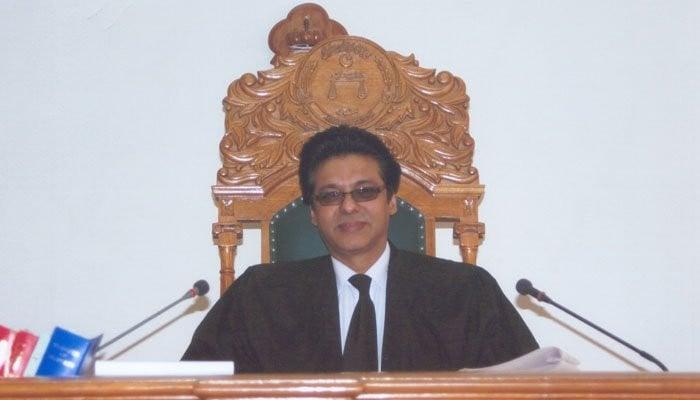
The judge of the Supreme Court Muhammad Ali Mazhar stressed that an examination of a judgment or an order is a serious legal measure which should only be undertaken when there is a clear and undeniable surveillance or surveillance on the file which leads to a miscarriage of justice.
In an additional seven -page note written during the hearing of a review request, judge Mazhar wrote that if the error in the judgment was so obvious and apparent, so important that it had been noticed before the rendering of the judgment, the conclusion would have been different, then an examination petition is justified.
He observed that the Constitution does not impose any restriction on the power of the Supreme Court to examine its previous decisions or even to deviate from them.
“… The doctrine of Stare Decisis does not do on the way either, as long as the examination is justified because of its significant impact on the fundamental rights of citizens or in the interest of the public good. The court is also competent to examine its judgment or the SUO Motu order, without any official request.”
The note was published in parallel with a decision by a bench of three judges led by judge Syed Mansoor Ali Shah, who rejected the request for review and stressed the need to discourage the deposit of frivolous journals.
Judge Mazhar, in his additional note, said that the jurisdiction of the SC exam is not a rescue option for unsuccessful unit to reopen business, but a closely defined judicial tool intended to correct flagrant and consecutive errors.
He observed that, although the interpretation of the provisions of the law or the constitution, certain errors could be apparent to the face of the file and cause substantial injuries, requiring corrective intervention to maintain justice.
Such cases, he explained, may include the discovery of new and significant evidence that was not available despite reasonable diligence, an error or an error clearly visible to the file, or any other sufficient cause. The reason for “exposed errors on the back of the file,” he added, applies to civil and criminal examination.
“For such a review to be entertained, the specific terrain must not only be mentioned in the lawyer’s certificate, but also be visibly identified in the magazine petition, rather than counting on scanning or irrational fields having no connection with the case,” said the note.
“It is undoubtedly the duty of the judges of the Supreme Court to correct their errors, because the principles of law set out in their judgments bind all the other courts of the country under article 189 of the Constitution.”
“The ordinances based on an erroneous hypothesis of important facts, or those taken without announcement to a provision of law, or reflecting a difference in the undisputed construction of the law and the constitution, can equip an apparent error in the face of the file and can be rectified.”
Judge Mazhar expressed his concern about the growing tendency to deposit revision petitions without discrimination, often supported by certificates of defenders who simply repeat the arguments already discussed in the initial case.
“At the moment, it has become a personalized or routine practice to file requests for revision intimately and unfairly, on the basis of certificates issued by defenders who simply imitate the reasons already exhorted and decided in the petition or the main call, without specifying any real error in the judgment or order which deserves its inversion.”
He noted that it was high time that the practice was denounced and condemned, because it constituted “nothing other than a waste and a exhaustion of the precious time of the court and imposes an unnecessary burden on its file”.


