“Even though cases have declined, the conditions that led to the resurgence of this deadly disease in recent years remain and must be corrected.“, said Regina De Dominicis, Regional Director of the United Nations Children’s Fund (UNICEF) for Europe and Central Asia.
Fifty-three countries in Europe and Central Asia reported 33,998 measles cases in 2025, compared to 127,412 in 2024.
The overall downward trend in cases reflects both outbreak response measures and the gradual decline in the number of people at risk of being infected with measles as the virus spreads in under-vaccinated communities, according to UN agencies.
Fighting deadly misinformation
However, many cases could have been avoided with higher routine vaccination coverage at the community level and a quicker response to outbreaks, UN agencies said.
“Until all children are vaccinated and the hesitancy fueled by the spread of misinformation is lifted, children will remain at risk of death or serious illness measles and other vaccine-preventable diseases,” she warned.
Hans Henri P. Kluge, WHO regional director for Europe, said measles elimination is essential for national and regional health security, emphasizing that “in today’s environment of widespread fake news, it is also crucial that people rely on verified health information from trusted sources such as WHO, UNICEF and national health agencies.
Measles still present
The number of cases in 2025 still exceeds those reported in most years since 2000.and some countries reported more cases in 2025 than in 2024. Measles cases continue to be detected in 2026 in the region, according to WHO.
“More than 200,000 people in our region have contracted measles in the past three years,” said Dr. Kluge.
“Unless every community achieves 95 percent vaccination coverage, closes immunity gaps across all ages, strengthens disease surveillance and ensures rapid response to outbreaks, this highly contagious virus will continue to spread.”
Very contagious
Measles is one of the most contagious viruses affecting humans. For every person with measles, up to 18 other unvaccinated people will become infected.
This makes measles is about 12 times more contagious than the flu. In addition to hospitalizations and deaths, the virus can cause debilitating long-term health complications.
It can also damage the immune system by “erasing” its memory of how to fight infections for months or even years, leaving measles survivors vulnerable to other illnesses and death.
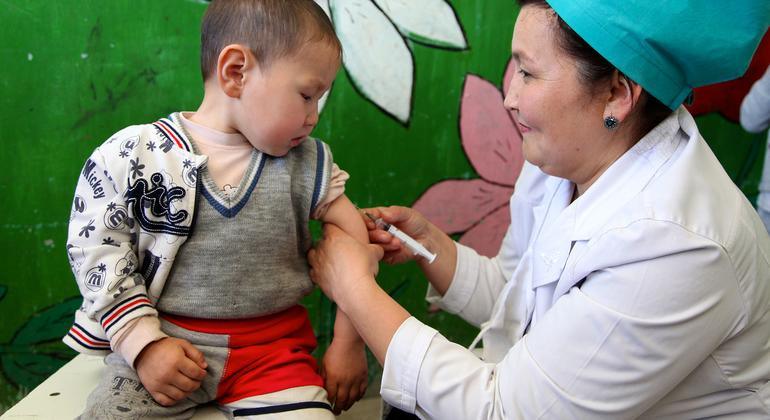
Two doses of measles vaccine provide up to 97 percent lifetime protection against measles.
A 95 percent vaccination rate with two doses of measles vaccine in every community each year is necessary to prevent measles outbreaks and achieve herd immunity, which protects infants too young for measles vaccination and others for whom such vaccination is not recommended due to medical conditions, such as those who are immunocompromised.
Public health priorities
Preparing for and responding to epidemics, as well as the goal of eliminating measles, remain public health priorities.
UNICEF and WHO are working together with governments and with the support of partners, including Gavi, the Vaccine Alliance and the European Union, to prevent and respond to measles outbreaks, including:
- engage with communities
- train health workers
- strengthening immunization programs and disease surveillance systems
- launch catch-up campaigns in terms of measles vaccination