
Strategy (MSTR), the world’s largest publicly traded Bitcoin holder, announced on Monday that it purchased 4,871 BTC for $330 million, marking one of its largest acquisitions of 2026.
However, a recurring question remains: why do these large purchases fail to move the market? In fact, the price of Bitcoin often drops around the time these announcements are made.
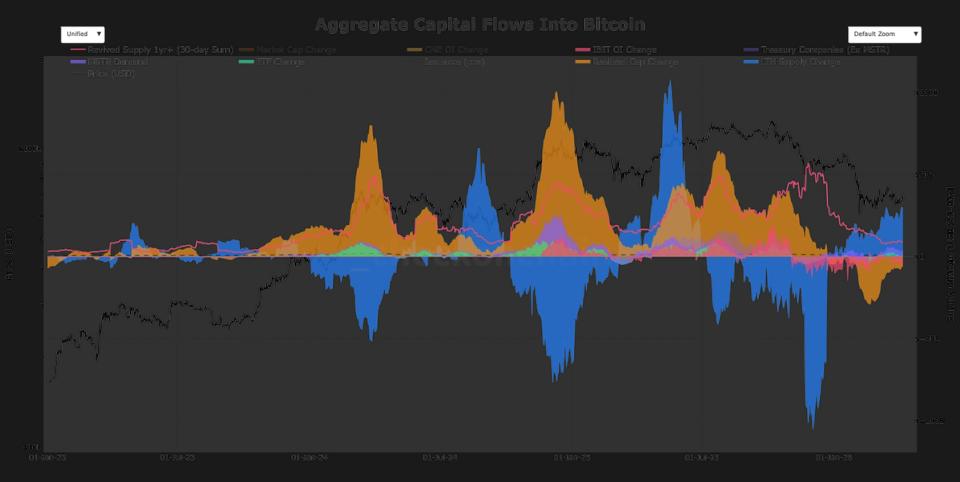
The answer lies in understanding market flows. Demand for MSTR currently represents around 7% of total gross inflows, and reaches around 9% of net flows, according to checkonchain data. Gross flows reflect only positive demand entering the market, while net flows represent both purchases and sales, giving a clearer picture of overall pressure. Although Strategy remains a consistent buyer, its impact is relatively small compared to broader market forces.
Historically, its influence was greater. Demand for MSTR peaked at over $15 billion in November 2024, coinciding with its all-time high stock price and bitcoin above $100,000. Since then, activity has normalized to a range of $1 billion to $4 billion, with current demand at around $2.8 billion over the past 30 days.
The dominant force is long-term holders (LTH), coins held for more than 155 days, which generate approximately $28.5 billion in supply change. A key subsection is the relaunch of 1+ year supply – older parts moving on-chain in the last 30 days – which represents around $9 billion in change.
Elsewhere, US spot exchange-traded funds (ETFs) added around $1 billion in inflows over the past 30 days, while miner issuance, at a rate of 450 BTC per day, contributes around $880 million in monthly supply pressure.
More importantly, capital continues to leave. Bitcoin’s realized cap has seen a $29 billion decline since February over a 30-day window, while BlackRock’s IBIT open interest is down more than $4 billion. Together, these releases dwarf MSTR demand.
The purchasing strategy may be aggressive, but it is overtaken by larger forces distributing supply and the withdrawal of capital from the system.


