
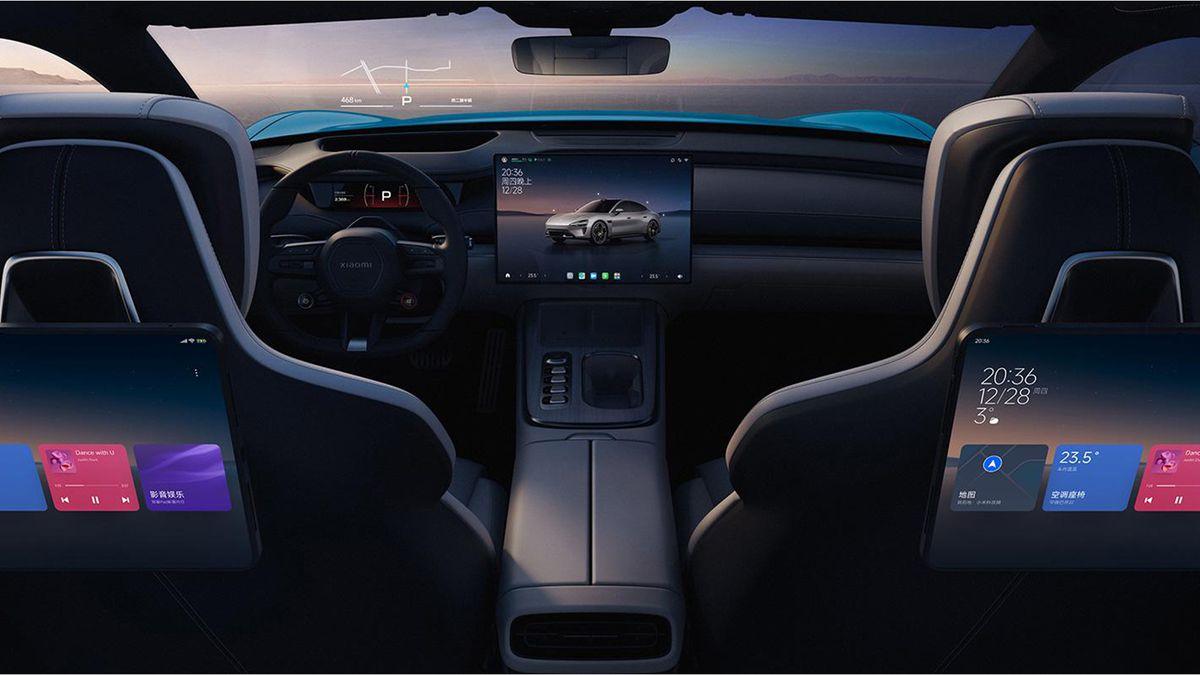
- A new study predicts that 15 million new Chinese cars will have autonomous technology
- Affordable models will be capable of level 2 SAE self-deputy
- China seems to be adjusted to accelerate autonomous vehicles
A new study revealed that around 15 million new cars sold in China will be equipped at least level 2 autonomous capabilities of SAE this year, including models below 100,000 yuan (which represents less than $ 14,000) , according to south of southern China in China, a position.
China EV100, which is a non -governmental organization which includes key players from the largest manufacturers of electric vehicles in China, says that two new cars in three sold on the continent will have autonomous driving capacities this year. This, at least, will allow them to speed up, slow down and modify the driver’s without entry tracks.
When this type of advanced driver assistance system (ADAS) was once the reserve of more expensive models, mass production of technology has forced prices at a point where even the most affordable vehicles can now offer them.
As a rapid summary, level 2 SAE autonomous vehicles offer partial automation, so that they can accelerate, slow down and even direct, as long as the driver is always ready to take control, with hands on the wheel in case Or.
Adaptation to level 3 of the SAE allows drivers to remove the hands from the steering wheel and road eyes, with the possibility of engaging with emails on the vehicle infotainment system, for example.
Currently, this level is only legally available on a handful of models and only in specific driving conditions in certain regions of the world, with Mercedes-Benz and BMW opening the way.
Despite what Elon Musk says, Tesla is still very at the SAE 2 level until the legislation allows full driving unattended on public roads.
In China, many car manufacturers have already seen the potential of autonomous driving, the UBS Xu bin analyst predicting that Chinese companies could save around 1.8 billion of yuan in annual labor costs by 2030 While thousands of trucks become driverless, according to South China Morning Post.
Analysis: China builds an entirely autonomous future
In China, the autonomous experience does not come with the same stigma that it makes in a large part of the Western world, where drivers generally be wary of its capacities.
On the contrary, young Chinese buyers are actively looking for the latest technologies when purchasing new vehicles, with increasing levels of autonomy on the shopping list.
By forcing the cost of the camera, the technology of the LIDAR, the sensor and the chipset is required (does not enter into how China has managed to do it here), the country was able to introduce it to the mass scale.
It is widely agreed that higher levels of automation on the road will only really work when vehicles equipped with required technology reach a critical mass.
There is a much thinner chance to perform if everyone on the highway uses an automatic pilot system, for example.
Despite this, there are still large car players in China who do not believe that we will reach a point where a human is not involved. One of the spokespersons of Byd told journalists at the Shanghai Auto Show in 2023 that he was “fundamentally impossible”.
But with two new cars out of three sold in China this year meeting the basic autonomous driving requirements, it will not take long before certain parts of the country can legitimately allow much higher levels of autonomous activity on public roads.
These technological prowess would facilitate the geo-clip of certain areas where level 3 SAE systems are compulsory, for example.
Alternatively, the country could even legislate that each new car sold must be able to adapt automatically to the speed limits, to maintain the tracks and to brake independently, thus creating a more predictable environment so that autonomous vehicles thrive.
It is believed that the full autonomous system of Tesla, often considered one of the most advanced in the world, will begin to test in China this year.
With a more favorable framework, Elon Musk’s predictions of a fully autonomous future could well come true … only 7,000 miles from the place where it was designed for the first time.


