
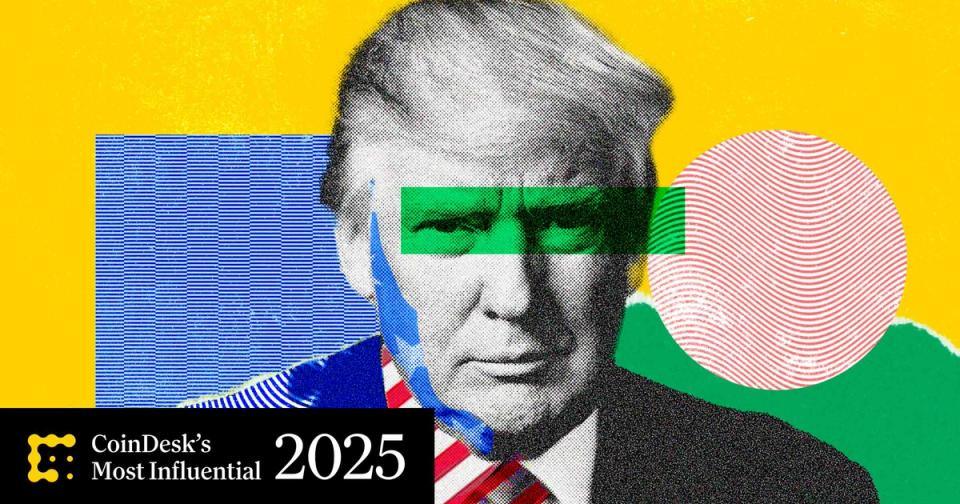
US President Donald Trump has not written a crypto policy. It has not negotiated legislation or developed regulatory guidelines. But without the White House’s sweeping demands and the pressure he put on his political allies in Congress, it’s hard to imagine the industry would have enjoyed the many major successes it celebrated in its first year back in office.
This feature is part of CoinDesk 2025 Most Influential List.
Between his first and second administrations, Trump made a stunning turnaround from his early suspicions of digital assets, not only jumping aboard the industry bandwagon but also demanding a role as a new conductor. The same chairman whose Securities and Exchange Commission (then under former Chairman Jay Clayton) sued Ripple, kicking off the industry’s regulatory-by-enforcement approach, arrived for his second term on a wave of pro-crypto campaign promises.
Trump has largely delivered on his promises, signing several executive orders that set an agenda for his regulators and Congress, and appointing regulators who would put pro-crypto policy work high on their priority lists. The president has said he will make the United States the world leader in crypto, and his digital assets team has promised a “golden age” for crypto. Trump ordered a comprehensive US regulatory regime for digital asset activities and for stablecoin issuers. He also called for two cryptocurrency stocks as long-term federal investments, the first such “strategic reserve” in Bitcoin. and the second in every second token.
So far, this ambitious program is incomplete.
Trump was able to hold a big celebration at the White House when Congress managed to thread a difficult needle to pass his stable bill through the once-recalcitrant Senate, with Trump demanding that the House of Representatives approve the legislation without additional changes. The Guiding and Establishing National Innovation for American Stablecoins (GENIUS) Act has become the law of the land, with the president babbling at a gathering of top crypto CEOs and members of his cabinet.
This was clearly an appetizer before the main course: a bill that would clearly define how digital assets would be defined and how transactions with them would be overseen by the federal government.
This is where Trump’s efforts failed. While his allies managed to get a market structure bill to the House, where it passed with unusual cross-party support, it came to a screeching halt in the Senate. Despite the ambitious summer deadline set by Trump, it is in the Senate that laws often languish. The reasons are numerous, including its more restricted access to speaking time, the fact that it generally requires a bipartisan majority of 60 votes to move anything forward, and there is greater ability for individual members to put spokes in the wheels. It didn’t help that Congress’s inability to act on a budget closed the doors to the federal government for weeks amid legislative negotiations.
Democrats have significant complaints and concerns in the bills unveiled by the Banking Committee and the Agriculture Committee. Much of their focus is on protecting consumers and preventing bad guys who abuse technology. But the most political and controversial reaction concerns the president himself.
When Trump changed his mind about crypto, he jumped in with his entire portfolio. He began to personally profit from non-fungible tokens (NFTs) featuring him in various heroic scenes. He and his family have gradually moved into almost every other sector of the crypto and blockchain industry, with a stake in World Liberty Financial, a Trump-themed memecoin launched just before he took office, a family push into crypto mining, and, most recently, with Trump Media & Technology Group plotting a jump into prediction markets. The clearest expression of this fusion of public service and private advantage is World Liberty Financial, the Trump-branded crypto firm that raised more than $550 million in a KYC token sale for its WLFI governance token even before its return. at the White House.
Public disclosures later showed that Trump family members controlled approximately 22.5 billion of WLFI, a stake valued at approximately $5 billion when the token began trading around $0.23 this fall. Since then, the project has attempted to evolve from a memecoin with MAGA aesthetics to a serious DeFi and payments play, introducing WLFI as a policy governance layer for its USD1 stablecoin and an incoming suite of “real-world asset” products.
Around WLFI, an entire complex of Trump plays took shape. Memecoins $TRUMP and $MELANIA spent much of 2024 speaking at every campaign rally, political headline and late-night TV monologue, briefly outpacing most of the altcoin market before giving back the bulk of their gains.
In June, Trump’s second son, Eric Trump, said World Liberty Financial would take a stake in the TRUMP token itself, tying the family’s flagship protocol to the most speculative corner of its own meme ecosystem and inviting comparisons to the FTX/Alameda loop.
There is almost no crypto route unexplored by Trump, who has reportedly made hundreds of millions of dollars from his digital asset projects. Since he also leads his administration’s crypto policies, congressional Democrats have taken strong exception to the apparent conflict of interest.
As recently as Dec. 2, during a House hearing on banking regulation, Trump-appointed officials said they agreed with rules barring regulators and Fed board members from engaging in bank ownership or management to avoid conflicts. But when asked whether the same standard should apply to a president controlling crypto policy while he has financial ties to the industry, they declined to answer.
Democrats on the House Judiciary Committee released a report declaring the situation represented a “new era of corruption.”
White House spokeswoman Karoline Leavitt denied there was a conflict of interest involving crypto at Trump or his family. “Through executive actions, supporting legislation like the GENIUS Act and other common-sense policies, the administration is delivering on the President’s promise to make the United States the crypto capital of the world by fostering innovation and economic opportunity for all Americans,” she told CoinDesk in a statement.
The actions with the most immediate effect for the crypto industry, however, may have been Trump’s appointments. Before this year, the industry widely viewed former SEC Chairman Gary Gensler as its chief government foe. Gensler’s SEC refused to write bespoke crypto regulations and instead guided the industry through a series of enforcement actions and court battles. But Gensler’s Trump replacement, Paul Atkins, launched “Project Crypto” and called its efforts — including policies around securities tokenization — his top priority.
Across financial agencies, Trump has installed regulators eager to meet the demands of his crypto orders. Their initiatives, such as the Commodity Futures Trading Commission’s efforts to get regulated platforms to offer leveraged spot crypto products, are already underway, well before a future market structure bill could emerge from Congress.
“To achieve President Trump’s vision of making America the crypto capital of the world, the SEC must comprehensively consider the potential benefits and risks of moving our markets from an off-chain to an on-chain environment,” Atkins said in the speech that introduced the Crypto Project. “President Trump said America is in its golden age – and under our new agenda, our crypto asset economy will be too,” he said.


