
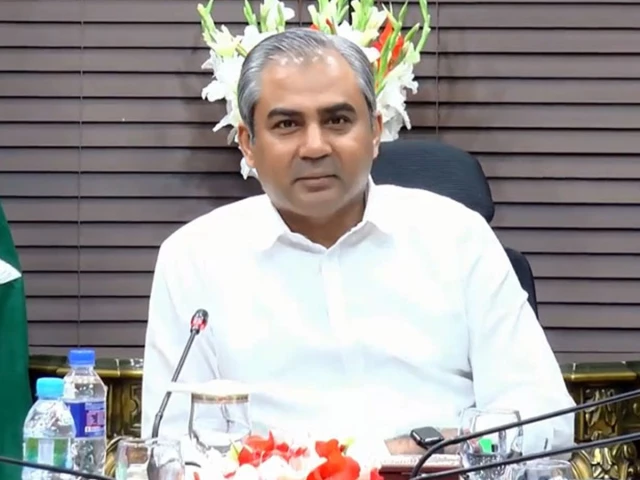
Interior Minister says those giving Pakistan bad name will face strict action
Interior Minister Mohsin Naqvi said professional beggars and people traveling with incomplete documents will not be allowed to travel abroad. Radio Pakistan reported.
He was addressing passengers during a visit to Allama Iqbal International Airport in Lahore on Sunday, accompanied by Minister of State for Interior Talal Chaudhry.
“Those who give Pakistan a bad name will face strict action,” Naqvi said, stressing the need to protect the country’s reputation. The Interior Minister also clarified that no passenger would be prevented from traveling without valid reason.
“Pakistan’s dignity and facilitating the travel of passengers are my top priorities,” he added. During the visit, Naqvi and Chaudhry inspected immigration counters and reviewed the departure process to ensure smooth operations at the airport.
Learn more: PM calls for tougher immigration controls
A day earlier, Prime Minister Shehbaz Sharif chaired a meeting at the Prime Minister’s House in Islamabad to review measures against human trafficking, undocumented foreign travel and weaknesses in the country’s immigration processes.
The Prime Minister was briefed on recent enforcement actions taken by the Federal Investigation Agency (FIA), including the arrest of 451 people involved in human trafficking and illegal immigration.
He also noted the airport inspections carried out by Mohsin Naqvi following complaints about the disembarkation of passengers, describing the intervention as timely and necessary.
The Prime Minister asked the authorities to ensure that passengers holding valid travel documents are not hampered by enforcement measures taken against illegal travelers.
He stressed the need to improve the performance of the Immigrant Protectorate and strengthen coordination between the FIA and other relevant institutions to avoid delays for legitimate travelers.
Highlighting the role of technology, the Prime Minister called for greater use of digital tools to improve the efficiency and transparency of immigration procedures. He further ordered authorities to take strict action against corrupt elements within law enforcement agencies, noting that 196 FIA officials and staff had already been dismissed after being found guilty of corruption.
Earlier on Thursday, the Federal Investigation Agency (FIA) revealed to a parliamentary committee that it had disembarked 66,154 passengers this year to combat organized gangs of beggars and illegal immigrants traveling abroad.
“The increase in offloading is multi-faceted,” FIA Director General Riffat Mukhtar told the National Assembly Standing Committee on Overseas Pakistanis and Human Resource Development, chaired by Syed Rafiullah.
The meeting was convened to review the growing phenomenon of passengers being prevented from boarding flights and the role and performance of the Community Welfare Attachés (CWA) network in protecting overseas Pakistanis.
During the meeting, DG FIA briefed the committee on the operational realities at ports of exit. The FIA director general said that 51,000 of these people were arrested due to the questionable veracity of their travel documents divided into three main categories: work visas, tourist visas and Umrah visas.
Read also: 66,154 air travelers disembarked this year
He pointed out that illegal immigration and begging networks seriously harm Pakistan’s international image. He reported that 56,000 beggars have been expelled from Saudi Arabia while the United Arab Emirates (UAE) has also imposed visa restrictions in the face of the phenomenon.
Mukhtar said illegal migration trends had been observed towards Africa, and even regarding tourist visas to countries like Cambodia and Thailand. The FIA official defended the strict measures needed to combat human trafficking and protect Pakistan’s international reputation.
He stressed that the increase in unloading is a countermeasure against fraudulent migration networks, revealing that 56,000 people involved in organized begging were recently deported from Saudi Arabia.
He pointed to increasing restrictions imposed by the United Arab Emirates and new illegal migration routes to Africa and Europe as factors warranting increased vigilance.


