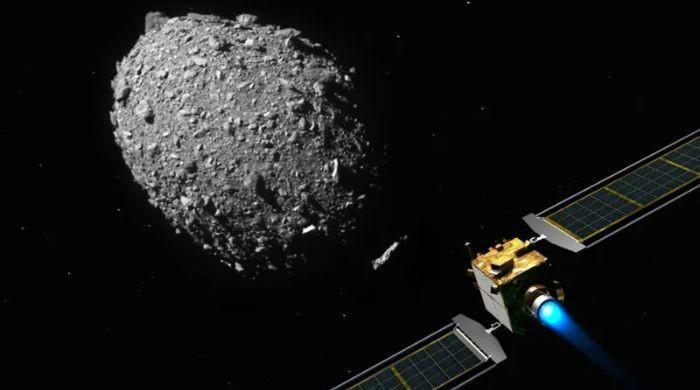
In a groundbreaking development, researchers at the National Aeronautics and Space Administration (NASA) have discovered that humans successfully diverted an asteroid from its regular orbit around the Sun in an experiment in 2022, marking a historic first in planetary defense.
In 2022, NASA scientists deliberately crashed a spacecraft into a small asteroid moon, Dimorphos, and successfully altered its trajectory around its parent asteroid, Didymos.
For context, a moon is a very small natural satellite, usually less than 1 to 2 km in diameter, that orbits a planet, dwarf planet, or asteroid.
Now, researchers have discovered that the first-ever successful demonstration of the human ability to change the trajectory of an asteroid also caused both asteroids to deviate from their regular orbits around the Sun.
A recent study published in the journal Science Advances found that the spacecraft’s collision with the moon caused Didymos’ speed to slow by 11.7 micrometers per second.
Researchers at the University of Illinois at Urbana-Champaign determined this change after examining more than 6,000 orbital spins of the asteroid around the star.
This means that future missions could target moons around asteroids to change their orbits, if they pose a threat to Earth.
The lead scientist for small solar system bodies at NASA Headquarters in Washington, Thomas Statler, hailed the incredible success achieved with the Double Asteroid Redirection Test (DART).
He said: “This is a small change in the orbit, but given enough time, even a small change can turn into a significant deviation. »
Despite this success, NASA warned that no other DART-type spacecraft were ready to launch if the need arose.