
ISLAMABAD:
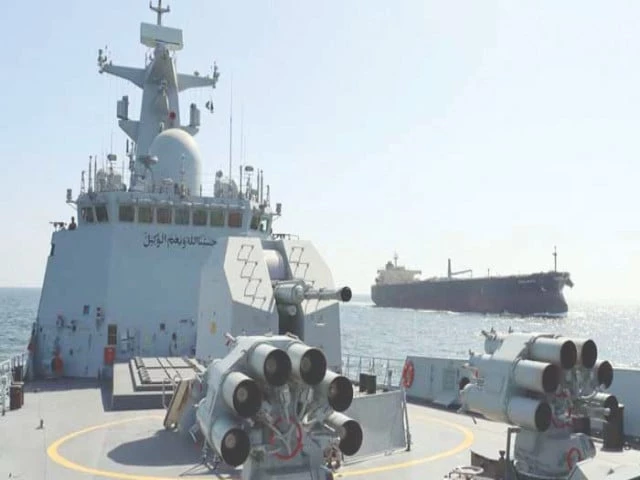
Authorities clarified on Wednesday that naval escort operations currently carried out by the Pakistan Navy are limited to protecting the country’s merchant ships operating along key maritime routes between Karachi and the Gulf and Red Sea regions, amid heightened security concerns triggered by the ongoing war between Iran, the United States and Israel.
Well-placed security sources told The Express PK Press Club that the escort operations announced under Operation Muhafiz-ul-Bahr should not be interpreted as Pakistani warships accompanying ships in the Strait of Hormuz, where tensions have sharply escalated due to the conflict.
“Escort operations are being conducted by the Navy for Pakistani ships sailing on the Karachi-Gulf and Karachi-Red Sea Lines of Communication (SLOC),” a senior security official said.
“This should not be misinterpreted as escorting ships through the Strait of Hormuz.”
The clarification comes after the Navy announced the launch of Operation Muhafiz-ul-Bahr earlier this week to safeguard Pakistan’s maritime trade and energy lifelines as the regional security environment becomes increasingly unstable.
The ongoing confrontation between Iran and the U.S.-Israeli alliance has sparked global concerns about the security of the Strait of Hormuz, a narrow waterway through which nearly a fifth of the world’s oil supply passes.
Iranian officials have repeatedly warned that continued military pressure could force Tehran to reconsider the security of maritime traffic in the strait.
Such warnings have roiled global energy markets and prompted countries dependent on maritime trade to reassess their contingency plans.
Pakistan, whose economy relies largely on maritime trade, is particularly exposed to disruptions to regional shipping routes.
Nearly 90% of the country’s trade passes by sea, while much of its oil imports pass through the Gulf before reaching Pakistani ports.
Officials said Operation Muhafiz-ul-Bahr is a precautionary measure to ensure that Pakistani-flagged vessels continue to operate safely despite growing uncertainty in regional waters.
According to the navy, the escort operations are carried out in coordination with the Pakistan National Shipping Corporation (PNSC), the country’s state-owned shipping company responsible for transporting a significant portion of Pakistan’s strategic cargo.
Security officials stressed that the escort operations were taking place along Pakistan’s established maritime supply routes rather than in the Strait of Hormuz itself, which remains one of the most sensitive hotspots in the ongoing conflict.
Analysts believe this clarification is important to avoid misinterpretations about Pakistan’s role in the evolution of the regional crisis.
The Navy’s direct involvement in escorting ships through the Strait of Hormuz could have significant geopolitical implications, given the intense military standoff between Iran and the US-Israeli alliance in the Gulf.
Instead, Pakistan appears to be focused on securing its own maritime trade corridors and reassuring commercial operators that shipping linked to Pakistani ports will remain protected.
The Navy has also increased surveillance of regional waters and is closely monitoring the movements of merchant ships to ensure safe transit through potentially vulnerable areas.
International shipping companies have already begun to reassess risks in the Gulf region, with insurance premiums rising sharply and some ships reportedly changing their itineraries to avoid possible conflict zones.
For Pakistan, any prolonged disruption to shipping routes could have serious economic consequences, particularly at a time when global oil prices are already rising due to the conflict.
Officials say the naval operation aims to prevent supply chain disruptions and ensure the continued flow of energy imports and commercial goods.
While Islamabad has maintained a cautious diplomatic stance in the Iran-US-Israel confrontation, the launch of Operation Muhafiz-ul-Bahr highlights growing strategic concern in Pakistan over the potential spillover of the conflict into critical maritime corridors.
By securing its key maritime lines of communication, Pakistan hopes to protect its trade routes from the wider turbulence gripping the Gulf region.


