
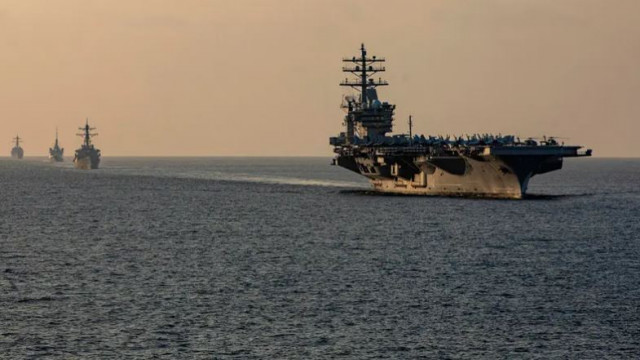
Components of the Dwight D. Eisenhower Carrier Strike Group (IKECSG), guided-missile destroyer USS Stethem (DDG 63) and French Navy frigate FS Languedoc (D 653) transit the Strait of Hormuz on November 25, 2023. PHOTO: REUTERS
ISLAMABAD:
What was billed as the most important talks in decades ended without a breakthrough, but also without a collapse, as the nearly 24-hour negotiations between the United States and Iran concluded Sunday in Islamabad, with both sides deepening their core demands while leaving the door open for deeper engagement.
US Vice President JD Vance, who led the US delegation, was the first to appear after the marathon negotiations, announcing that no agreement had been reached before leaving the capital.
“The bad news is we haven’t reached an agreement, and I think that’s bad news for Iran much more than it is bad news for the United States of America,” Vance told reporters shortly before leaving, in what marks the highest-level direct contact between Washington and Tehran since the 1979 Islamic Revolution.
Despite this stark assessment, Pakistan sought to present the result as a break rather than a failure. Prime Minister Shehbaz Sharif said the talks were “not dead”, calling the situation a “stalemate”, while expressing hope that diplomacy would eventually prevail.
Deputy Prime Minister and Foreign Minister Ishaq Dar, who played a central mediating role alongside the military leadership, insisted that Islamabad would continue to facilitate dialogue “in the days to come”.
The talks, which began Saturday afternoon, initially took place indirectly before morphing into a rare face-to-face engagement. Negotiations continued late into the night and into Sunday morning, highlighting both the complexity of the issues and the seriousness of the efforts being made.
By the time Vance spoke to reporters at an Islamabad hotel, the sun had already risen, marking the end of an intense diplomatic push that saw “numerous messages and texts” exchanged between the two sides. According to the officials, the discussions covered a wide range of controversial issues, including Iran’s nuclear program, the future of the Strait of Hormuz, sanctions relief, war reparations and a broader ceasefire framework following the recent six-week U.S.-Israeli conflict with Iran.
Vance made clear that Washington’s main demand remained unchanged: an unequivocal Iranian commitment not to pursue nuclear capability.
“We need an affirmative commitment that they will not seek nuclear weapons and they will not seek the tools that would enable them to quickly obtain a nuclear weapon,” he said. He added that Tehran had “not accepted our conditions,” indicating that fundamental differences persist.
Iranian officials, while acknowledging the lack of agreement, adopted a more measured tone. Foreign Ministry spokesman Esmaeil Baghaei said expectations of a quick deal were unrealistic given the depth of the disputes.
“From the beginning, we should not have expected to reach an agreement in one session,” he said, stressing that diplomacy would continue.
Baghaei stressed that the negotiations were part of a broader strategic effort, describing diplomacy as Iran’s continued struggle to safeguard its national interests. He also reiterated his deep distrust of the United States, citing past “breach of trust” and the recent conflict.
The Iranian delegation, led by Parliament Speaker Mohammad Bagher Ghalibaf, claimed to have presented “forward-looking” proposals but suggested that Washington had not yet demonstrated the will needed to bridge the gap. “The United States has understood Iran’s logic and principles, and it is time for it to decide whether or not it can earn our trust,” Ghalibaf said in a statement.
For Pakistan, hosting these negotiations was both a diplomatic gamble and an opportunity to reaffirm its relevance on the world stage. In a televised statement after the talks, Dar thanked both sides for responding to Islamabad’s call for a ceasefire and agreeing to negotiations.
He revealed that he and Chief of Army Staff Field Marshal Syed Asim Munir had facilitated “several rounds of intense and constructive negotiations” over the past 24 hours.
Dar stressed the importance of maintaining the ceasefire and expressed hope that the “positive spirit” demonstrated in Islamabad would ultimately translate into lasting peace. “Pakistan has played and will continue to play its role in facilitating engagement and dialogue,” he said.
Officials privately acknowledged that even if no deal had been reached, simply bringing the two adversaries to the table and keeping them in contact for nearly a full day was itself a significant achievement.
With a still deep trust deficit and entrenched positions, the Islamabad talks may not have resulted in the “deal of the century” that some were hoping for. Yet they appear to have laid the foundations for a longer, more gradual process.
Some observers have said that for now the result can be described as a lack of breakthrough, but also no rupture and just enough momentum to maintain hope.


