
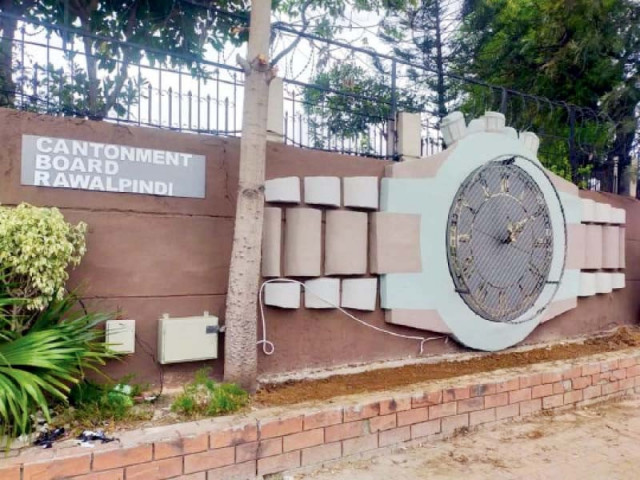
The Rawalpindi Cantonment Board has installed a huge clock at Telegraph Chowk, Mall Road. Photo: AGHA MAHROZ/EXPRESS
RAWALPINDI:
Despite an order from the Rawalpindi bench of the Lahore High Court (LHC), the interim notification of the cantonment boards has still not been issued even after a delay of 16 days instead of the stipulated five.
The elected representatives of the public have completed their four-year term and have consequently become inactive, while the date of elections in the country’s 44 cantonment councils also remains unannounced. In their absence, citizens struggle to resolve common civic issues.
The Department of Military Lands and Cantonments dissolved all 44 cantonment boards – including those in Rawalpindi, Lahore and Karachi – on November 11, 2025, at the end of their four-year tenure, by issuing written directives to all MLC regional directors to establish an interim mandate through the respective CEOs by November 26, 2025.
However, following a writ petition filed by the Vice President and elected members of Rawalpindi-Wah Cantonment, the Rawalpindi bench of the LHC disposed of the petition on December 23, 2025, ruling that the expired four-year term of the elected members could not be extended. The court ordered the government to inform the security company within five working days.
Despite the court order, no notification regarding the guarding arrangement has been issued so far in the cantonment boards across the country. According to cantonment board sources, a letter has been sent to the federal government and the notification will be issued after approval from the federal cabinet.
Currently, the situation leaves the cantonment boards without an elected body – rendered inactive upon the expiration of their term – nor without a court-mandated interim institution. It is also unclear when new elections will take place.
In the absence of elected officials, citizens are grappling with routine matters such as checking complaints about street lighting, sanitation, encroachments, building plans, taxation and issuing birth and death certificates – tasks for which they previously relied on elected officials.
The designated offices for the vice-president and elected members in Rawalpindi and Chaklala cantonments were closed and their auditing authority withdrawn.
The citizens demanded that an interim system be put in place without delay so that until fresh elections are held, a civilian appointee and a government member appointed in each cantonment council can facilitate the resolution of civic issues.


