
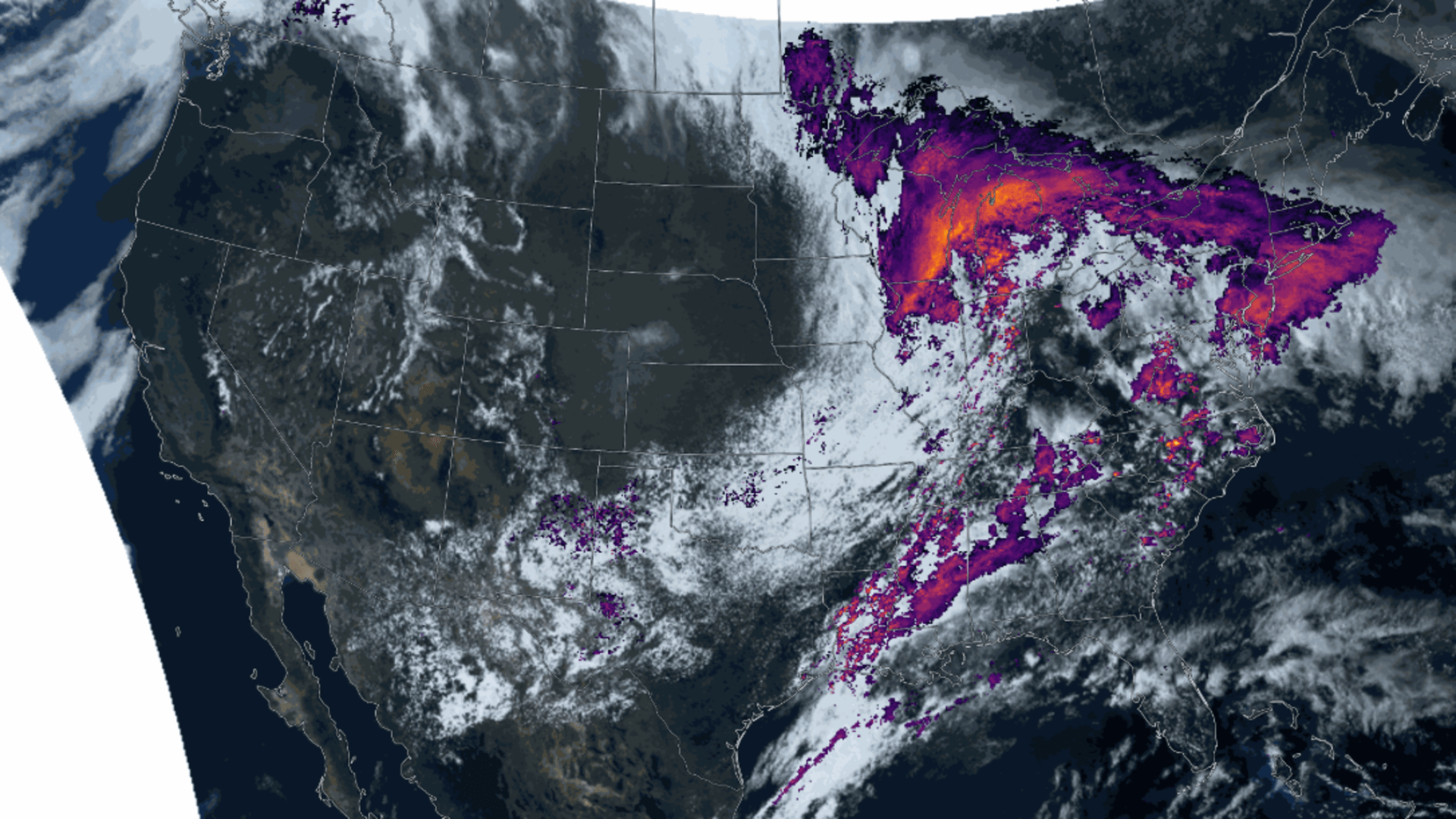
- Nvidia Earth-2 Speeds Up Weather Forecasting and Dramatically Reduces Computing Costs
- Earth-2 includes CorrDiff, FourCastNet3, Medium Range, Nowcasting, Global Data Assimilation and the PhysicsNeMo framework
- Energy Companies Leverage Earth-2 to Improve Grid Reliability and Photovoltaic Forecasting
Nvidia has unveiled its new Earth-2 family of open AI models, which it says could transform weather and climate forecasting as we know it.
The Nvidia Earth-2 family includes CorrDiff, FourCastNet3, Medium Range, Nowcasting, Global Data Assimilation, and the PhysicsNeMo framework for training and fine-tuning AI physics models.
These models integrate high-resolution data from satellites, radars and weather stations to provide continuous estimates of atmospheric conditions.
High-resolution modeling for rapid predictions
Earth-2 uses generative AI to accelerate every step of forecasting, from processing observational data to generating global and localized storm forecasts.
CorrDiff uses a generative AI architecture to reduce coarse continental forecasts into high-resolution regional forecasts, producing results up to 500 times faster than traditional methods.
FourCastNet3 provides accurate forecasts of wind, temperature and humidity, outperforming conventional ensemble models while delivering forecasts up to 60 times faster.
The system also integrates models from the European Center for Medium-Range Weather Forecasts, Microsoft and Google, allowing users to combine multiple approaches into a single framework.
Nvidia’s PhysicsNeMo enables AI physics models to train and refine at scale, providing flexibility for both operational predictions and scientific research.
Earth-2 Global Data Assimilation produces initial atmospheric conditions in seconds on GPUs rather than hours on supercomputers, enabling faster integration into downstream models.
Organizations in the research, energy, and government sectors are already using these AI tools to improve forecast accuracy and reduce computational costs.
The Israel Weather Service already uses CorrDiff and plans to deploy nowcast for high-resolution forecasts up to eight times per day.
Energy companies such as TotalEnergies, Eni and GCL are testing Earth-2 to improve grid operation, short-term risk awareness and photovoltaic forecasting.
Brightband and Taiwan meteorologists use Earth-2 CorrDiff and Medium Range to provide accurate global and local forecasts, and The Weather Company is currently evaluating the nowcast for very short-term local storm forecasts.
These AI tools reduce computational demand, with some models reporting a 90% reduction in computation time compared to traditional methods on processor clusters.
The open source availability of Earth-2 on platforms such as Hugging Face and GitHub allows researchers, companies and startups to refine forecasts of local conditions.
By combining multiple AI models and tools, organizations can generate probabilistic, actionable insights that inform decisions in agriculture, energy, disaster response, and insurance risk assessment.
“Philosophically and scientifically, it’s a return to simplicity… We’re moving away from niche, bespoke AI architectures and toward the future of simple, scalable transformer architectures,” said Mike Pritchard, director of climate simulation at Nvidia.
“This provides the fundamental building blocks used by everyone in the ecosystem – national weather services, financial services companies, energy companies – anyone who wants to create and refine weather forecast models.”
Follow TechRadar on Google News And add us as your favorite source to get our news, reviews and expert opinions in your feeds. Make sure to click the Follow button!
And of course you can too follow TechRadar on TikTok for news, reviews, unboxings in video form and receive regular updates from us on WhatsApp Also.


