
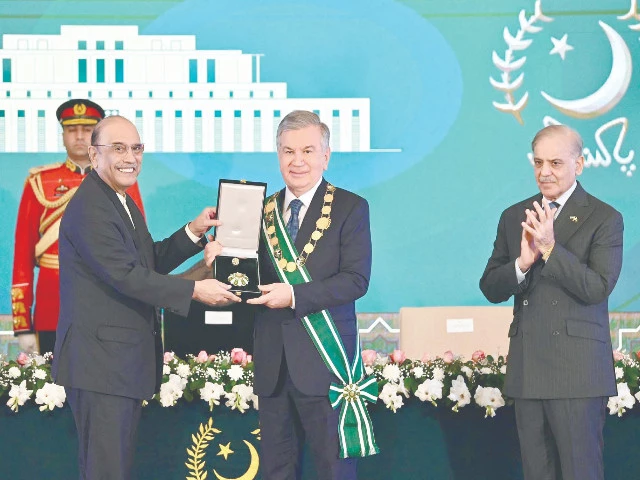
President Asif Ali Zardari confers Nishan-e-Pakistan on Uzbek President Shavkat Mirziyoyev during a special inauguration ceremony at Aiwan-e-Sadr as Prime Minister Shehbaz Sharif looks on. Photo: PPI
ISLAMABAD:
Prime Minister Shehbaz Sharif on Friday invited Uzbek companies to explore investment opportunities in Pakistan’s textile, pharmaceutical, mining, agriculture and tourism sectors, as private sector entities of the two countries signed MoUs worth $3.4 billion for B2B cooperation.
The prime minister, addressing the Pakistan-Uzbekistan Business Forum organized here with Uzbek President Shavkat Mirziyoyev, who is on a two-day state visit here, said the two sides signed a protocol on Friday to achieve an “ambitious but easily achievable” target of increasing bilateral trade to $2 billion in five years.
At the forum attended by ministers and businessmen from both sides, the two leaders assured investors of providing a conducive business environment, free from systemic obstacles.
Both leaders welcomed the B2B agreements with the Uzbek president, calling them “completely feasible” as both sides had already developed and established a very good agenda.
“I am here, of course, as the Prime Minister of Pakistan, but for this forum as the CEO of Pakistan. I am just a phone call away. My colleagues are just a phone call away. We will remove any bottleneck or obstacle in the way.
And I would like to assure you that bureaucracy and red carpet will not create any obstacles to your business proposals,” Prime Minister Shehbaz pledged.
The Prime Minister said that 30 idle textile factories in Uzbekistan could be a win-win opportunity for investors from both sides and expressed hope that PIA flights to Uzbekistan would strengthen people-to-people contacts.
In his speech, President Mirziyoev said that the business forum reflected long-standing common intentions and deep mutual understanding.
Calling business a “true bridge” between two nations, he said that through the $2 billion trade protocol, both sides had committed to zero corruption, no bottlenecks and no obstacles.
He said Uzbekistan needed Pakistan’s expertise and high quality in pharmaceutical sector, affordable medicines and provided 10-year tax exemptions, support and all enabling conditions.
He told the gathering that Uzbekistan has around 30 high-tech textile companies that are waiting for Pakistani leadership and expertise to access global markets, and also expressed his country’s keen interest in collaborations in the field of leather goods.
He invited Pakistani businessmen to visit Uzbekistan to study opportunities, draw up plans and start operations, assuring them all necessary support.
Later, the two leaders also witnessed the exchange of pre-signed MoU documents between the business entities of the two sides.
Strategic partnership
Pakistan and Uzbekistan on Wednesday reaffirmed their commitment to elevate bilateral relations to a qualitatively new level as President of the Republic of Uzbekistan Shavkat Mirziyoyev concluded a two-day state visit to Pakistan, marked by wide-ranging agreements on trade, connectivity, culture, security and regional cooperation.
In a joint statement issued at the end of the visit, the two sides underlined their determination to strengthen cooperation to support each other’s sovereignty, independence and territorial integrity, while advancing sustainable development aligned with long-term national interests.
“Pakistan and Uzbekistan are linked by deep historical, cultural and spiritual affinities. Our partnership is anchored in trust and shared aspirations for peace and prosperity in the region,” Prime Minister Shehbaz Sharif said during the talks.
On economic cooperation, the two sides reiterated their determination to achieve the ambitious bilateral trade target of $2 billion by 2029, recalling that Uzbekistan was the first Central Asian country to sign both a transit trade agreement and a preferential trade agreement with Pakistan.
The leaders welcomed progress in expanding the preferential trade agreement, signing a bilateral investment treaty, and efforts to align sanitary and phytosanitary measures and mutually recognize standards. They also agreed to promote joint ventures in pharmaceuticals, textiles, leather, agriculture, minerals and engineering goods, as well as enhanced cooperation on e-commerce.
Connectivity figured prominently in the discussions. Both sides welcomed the signing of the framework agreement on the Uzbekistan-Afghanistan-Pakistan (UAP) railway project and unanimously approved the Termiz-Kharlachi route. They reaffirmed their commitment to the rapid completion of the project, recognizing its importance for regional integration and economic development.
Pakistan reiterated its commitment to providing Uzbekistan with access to its seaports and road network of international standards for transit trade, while both sides committed to expeditious implementation of the Memorandum of Understanding on Multimodal Transport.
In the cultural domain, Pakistan and Uzbekistan have reaffirmed their common civilizational heritage rooted in the legacy of the Silk Road. The leaders welcomed the signing of an agreement on the preservation and promotion of Baburid heritage and pledged to expand cooperation through cultural festivals, academic exchanges and heritage conservation.
Memorandum of understanding to fight corruption
The Anti-Corruption Agency of the Republic of Uzbekistan (ACAU) and the National Accountability Bureau of the Islamic Republic of Pakistan have signed a Memorandum of Understanding (MoU) to strengthen mutual cooperation in the fight against corruption.
Nishan-e-Pakistan
President Asif Ali Zardari on Friday awarded the Nishan-e-Pakistan, the highest civilian honor, to Uzbek President Shavkat Mirziyoyev in recognition of his contribution to strengthening relations between Pakistan and Uzbekistan.
The special inauguration ceremony was held at Aiwan-e-Sadr and was attended by, among others, Prime Minister Muhammad Shehbaz Sharif, members of the federal cabinet, Chief of Air Staff Marshal Zaheer Ahmed Baber Sidhu, members of the diplomatic corps and parliamentarians, and was followed by a state banquet organized in honor of the visiting President.


