
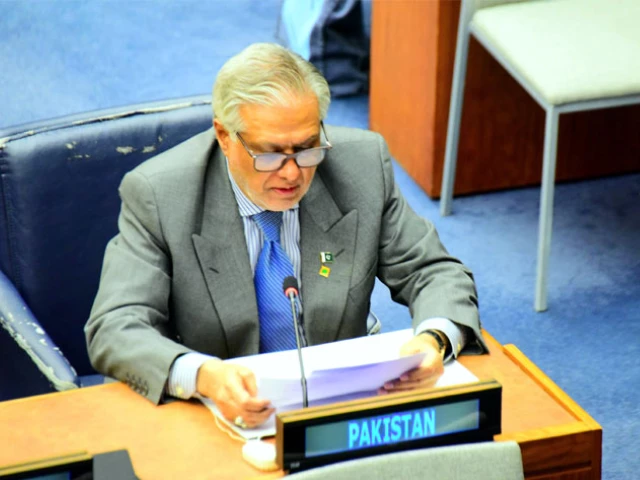
Ishaq Dar speaking at a high-level OIC event on peace and tolerance on the sidelines of the 80th session of the United Nations General Assembly
ISLAMABAD:
Pakistan on Friday accused India of deliberately manipulating river flow in violation of the Indus Waters Treaty (IWT), warning that New Delhi’s actions threaten regional stability, international law and the livelihoods of millions of people downstream.
Addressing the diplomatic corps in Islamabad, Deputy Prime Minister and Foreign Minister Senator Ishaq Dar said India’s decision earlier this year to suspend the Indus Waters Treaty of 1960 amounted to a “gross violation” of international law, including the Vienna Convention on the Law of Treaties.
He said Pakistan was now witnessing “substantial violations” of the treaty, citing unusual and abrupt variations in the flow of the Chenab River twice this year – from April 30 to May 21, and again between December 7 and 15.
“These sudden changes in river flow indicate unilateral water releases by India, carried out without prior notification or sharing of data, as explicitly required by the treaty,” he said, adding that such actions were “of extreme concern” to Pakistan.
The foreign minister said Pakistan’s Indus Water Commissioner had formally sought clarification from his Indian counterpart under the treaty provisions, warning that India’s conduct amounted to “weaponization of water.”
He said the timing of the water manipulation was particularly alarming as it coincided with a critical phase in Pakistan’s agricultural cycle, directly threatening food security, livelihoods and the economy as a whole.
The minister accused India of systematically undermining the treaty by building hydropower projects such as Kishanganga and Ratle, which he said violated the treaty’s technical specifications, as well as building dams aimed at creating faits accomplis.
“As storage capacity increases, India’s ability to manipulate water flows increases, endangering the security, economy and livelihoods of Pakistan’s 240 million people,” he said.
He also said India had disrupted hydrological data sharing and joint monitoring mechanisms mandated by the treaty, exposing Pakistan to increased risks of floods and droughts, and warned that continued violations could trigger a humanitarian crisis.
Referring to recent decisions of the Permanent Court of Arbitration in June and August 2025, the minister said the court had reaffirmed the continued validity of the Indus Waters Treaty and its binding dispute resolution mechanisms.
“These decisions leave no ambiguity. The treaty is alive and its provisions remain binding,” he said, criticizing India for its refusal to participate in arbitration and neutral expert procedures.
The minister also cited a recent communication from the UN special rapporteurs expressing concern that India’s actions risk violating human rights, including the rights to water, food, livelihoods and a healthy environment.
He said Pakistan had raised the issue several times in the UN Security Council and urged the international community to put pressure on India to restore the treaty, refrain from unilateral action and respect international law.
“Pakistan remains committed to resolving disputes peacefully,” he said, adding “but will not compromise on the existential water rights of its people. Water is life and cannot be weaponized.”
“India continues to build illegal dams, in total disregard of Treaty obligations, to impose a ‘fait accompli’. With the construction of dams, India’s capacity to store and manipulate water also increases, endangering the security, economy and livelihoods of 240 million Pakistanis.
He said allowing India to violate Treaty obligations with impunity would set a dangerous precedent as the country would hijack the Treaty’s dispute resolution mechanism by refusing to participate in the Court of Arbitration and neutral expert proceedings.
The Deputy Prime Minister stressed that the CIES was a binding legal instrument and any unilateral violation would threaten the sanctity of international treaties and pose serious threats to regional peace and security, the principles of good neighborliness and the norms that govern interstate relations.
He said the Permanent Court of Arbitration, in its recent decisions in June and August 2025, reaffirmed the continued validity of the IWT and its binding dispute resolution mechanisms.
“These decisions leave no ambiguity. The Indus Waters Treaty is alive and its provisions remain binding on the parties. Indian impunity must not be accepted by the international community.”
Dar reiterated that Pakistan’s National Security Committee had declared that any attempt to stop or divert the flow of water to Pakistan under the Treaty would be considered an “act of war”.
He urged the international community to take note of India’s continued disregard for a bilateral treaty and advise India to act responsibly in accordance with international law and established norms.
He said that the belligerent statements of the Indian leadership clearly demonstrated Indian intentions and plans to weaponize water with the aim of harming Pakistan, which was also repeatedly conveyed to the UN Security Council, the UN Secretary General as well as the President of the UN General Assembly to play their due role.
“Let me assure you that Pakistan remains committed to peacefully resolving differences and issues with India, but will not compromise on the existential water rights of its people,” he said.
The Deputy Prime Minister urged the international community, particularly members of the UN Security Council, to take immediate steps to address this situation and called on India to immediately reinstate the Treaty, end water militarization, respect international law and treaty obligations, and refrain from undermining the peace and stability of South Asia.


