
Prime Minister says Pakistan is a unique hub of economic corridors connecting China, Central Asia and the Middle East
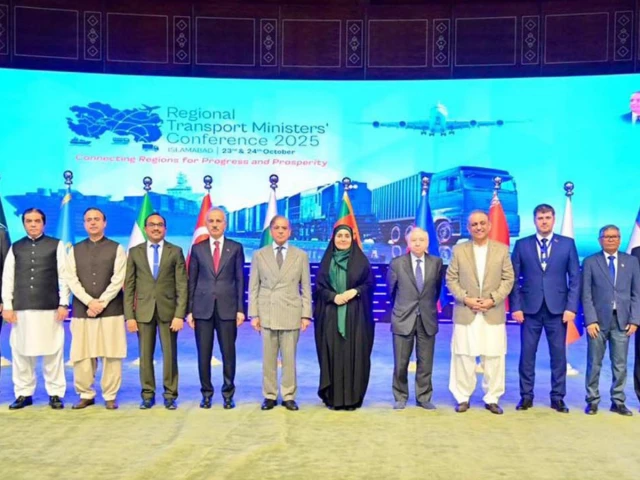
Prime Minister Muhammad Shehbaz Sharif poses for a group photo with world leaders during the Regional Conference of Transport Ministers held in Islamabad on Friday, October 24, 2025. Photo: APP
Prime Minister Shehbaz Sharif said Pakistan constitutes a “unique tri-junction” of economic corridors connecting China, Central Asia and the wider Middle East, serving as a vital link between markets and people while opening new avenues of trade and energy cooperation.
Addressing the concluding session of the two-day Regional Transport Ministers Conference – themed “Regional Connectivity: Opportunities for the Region” – the Prime Minister highlighted Pakistan’s central geographical and economic role in regional integration.
The event, organized by the Ministry of Communications, was attended by transport ministers and delegates from 20 countries, as well as representatives from the Asian Development Bank (ADB), the Economic Cooperation Organization (ECO) and the International Road Transport Union (IRTU).
“This would strengthen our common interest in peace and strengthen development efforts in the region,” Shehbaz said. “Let us sow the seeds of cooperation together so that we can reap the fruits of development and prosperity for our people, our region and beyond. »
Learn more: PM urges Qatar to invest under ITFC, hails Doha’s role in Pakistan-Afghanistan ceasefire
Highlighting the importance of CPEC and other transnational rail and road initiatives, the Prime Minister said these connectivity projects would help create synergy between regional economies and pave the way for a new era of enhanced trade, economic and energy cooperation.
“For centuries, today’s Pakistan has thrived on connectivity – from the ancient Silk Road to today’s Belt and Road Initiative,” he noted. “Changing geopolitical dynamics and the growing dominance of economic priorities have breathed new life into this ancient corridor, transforming it from a relic of the past into a strategic necessity for our future. »
Prime Minister Shehbaz said Pakistan’s geography, connecting the warm waters of the Arabian Sea and the Persian Gulf, placed it at the confluence of China, the Eurasian land bridge and the Middle East. He said the country’s long coastline made Gwadar and Karachi ports key transit points on the Maritime Silk Road.
Hailing the vision of his brother and former Prime Minister Nawaz Sharif, the Prime Minister said the signing of the China-Pakistan Economic Corridor had been a transformative step connecting the markets of China, Central Asia, South Asia and the Middle East.
Read also: SP among three martyrs in Hangu blasts as police kill two terrorists in operation
He said Pakistan is now entering an “exciting” new phase of CPEC 2.0 focused on promoting business-to-business partnerships, attracting Chinese investments and deepening mutual prosperity.
Additionally, the Prime Minister mentioned several ongoing railway projects, including the Trans-Afghan Railway and the Islamabad-Tehran-Istanbul corridor, as well as projects to improve air connectivity with Central Asian states under frameworks such as the TIR Convention.
Considering that connectivity “is not just about roads and railways”, he said, Pakistan is also investing in digital infrastructure to prepare for the fourth industrial revolution. “We may not have black gold, but our youth, 60% of whom are between 15 and 30 years old, is our greatest wealth,” he stressed.
In his closing remarks, Communications Minister Abdul Aleem Khan said participants reaffirmed their commitment to strengthening connectivity as a pathway to shared prosperity. He said the conference focused on creating new linkages, developing innovative financing mechanisms and promoting partnerships with international financial institutions.
Participants, he added, also called for liberal visa regimes, improved road safety measures and closer collaboration to achieve sustainable regional growth.


