
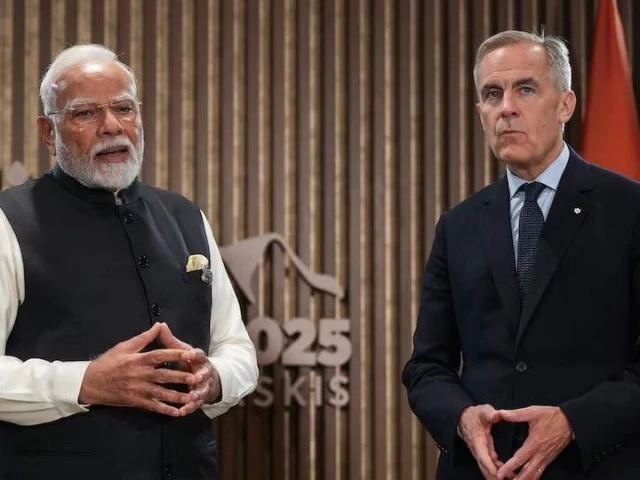
Indian Prime Minister Narendra Modi met Prime Minister Mark Carney at the G7 summit on Tuesday. Canada’s intelligence agency warns in a new report that the country remains a source of foreign interference. PHOTO: THE CANADIAN PRESS
ISLAMABAD:
Pakistan on Thursday expressed concerns over a long-term uranium supply deal and nuclear cooperation agreement reached between India and Canada during Canadian Prime Minister Mark Carney’s recent visit to New Delhi, warning that such country-specific agreements risk undermining the global nuclear non-proliferation framework and destabilizing the strategic balance in South Asia.
The deal, which includes a long-term supply of uranium and cooperation in advanced nuclear technologies, was announced after talks between Carney and Indian Prime Minister Narendra Modi, as the two sides worked to repair ties and expand economic cooperation.
The agreement is part of a broader initiative to strengthen bilateral cooperation on trade and energy, including collaboration on small modular reactors and advanced nuclear technologies.
The uranium supply deal, worth an estimated $2.6 billion, will allow Canadian companies to supply nuclear fuel to support India’s civilian nuclear energy program as New Delhi expands its nuclear capacity.
Reacting to the development, the Ministry of Foreign Affairs said the agreement represented another exception in the field of civil nuclear cooperation extended to India despite long-standing concerns over its nuclear program.
“Pakistan has noted with concern the long-term uranium supply agreement between Canada and India and the potential cooperation between the two parties on small modular reactors and advanced reactor technologies,” Foreign Ministry spokesperson Tahir Andrabi said in a statement.
“This arrangement represents yet another country-specific exception in the field of civilian nuclear cooperation. It is particularly ironic given that India’s 1974 nuclear test, carried out with plutonium produced in a reactor supplied by Canada for peaceful purposes, had led directly to the creation of the Nuclear Suppliers Group (NSG),” he added.
The spokesperson said a state whose actions necessitated the establishment of global export controls now benefits from preferential access under selective agreements.
“India has neither placed all of its civilian nuclear facilities under International Atomic Energy Agency safeguards, nor made any binding commitment to do so under this agreement. Several facilities remain outside international inspections. It is also unclear what, if any, concrete non-proliferation guarantees accompany this agreement.”
Andrabi added that the strategic consequences were equally troubling.
“Secured external supplies of uranium effectively free up India’s domestic reserves for military purposes, enabling the expansion of its fissile material stockpiles, accelerating the growth of its nuclear arsenal, and deepening existing asymmetries in South Asia’s strategic balance.”
“In this context, the agreement also undermines Canada’s commitment to the international non-proliferation regime and its corresponding obligations thereunder,” the spokesperson said.
Pakistan reiterated that civil nuclear cooperation must be governed by a non-discriminatory approach based on criteria applicable also to States that are not parties to the Nuclear Non-Proliferation Treaty (NPT).
“Selective exceptions diminish the credibility of the global non-proliferation framework and risk further destabilizing regional and global peace and security.”
Separately, Deputy Prime Minister and Minister of Foreign Affairs Ishaq Dar held a telephone conversation with Canadian Foreign Minister Anita Anand, during which the two sides discussed bilateral relations and ways to further strengthen economic cooperation.
Although the official reading does not say so, the issue of the Canada-India nuclear deal was raised during the telephone conversation.
According to the Ministry of Foreign Affairs, the two leaders explored avenues to expand cooperation in several sectors, including agriculture, clean energy and essential minerals, while emphasizing the importance of strengthening people-to-people ties between Pakistan and Canada. Anand also appreciated the contribution of the Pakistani diaspora in Canada.
“Both sides stressed the importance of sustained high-level exchanges to maintain the positive trajectory of bilateral engagement,” the statement said.
The two foreign ministers also exchanged views on evolving regional developments, with Dar emphasizing the importance of dialogue, diplomacy and respect for international law to promote de-escalation and stability in the Middle East and the wider region.
Pakistan has long opposed selective nuclear cooperation agreements with India, arguing that civilian nuclear collaboration should be based on a uniform, criteria-based framework, applicable to all states not signatories to the Treaty on the Non-Proliferation of Nuclear Weapons and consistent with the principles of the Nuclear Suppliers Group and the International Atomic Energy Agency.


