
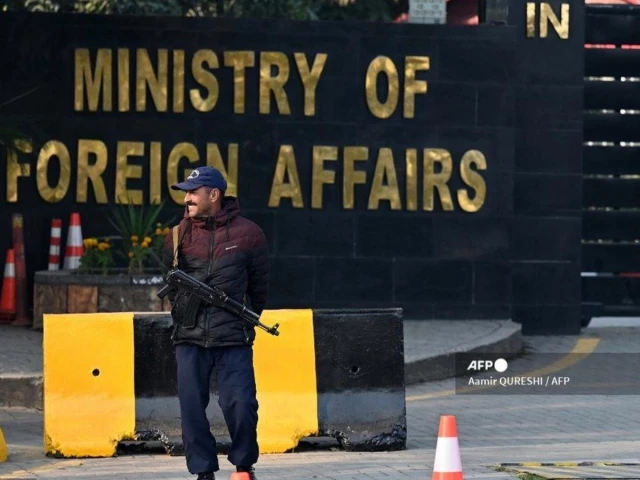
“Selective exceptions diminish the credibility of the global non-proliferation framework,” said Foreign Ministry spokesperson Tahir Andrabi.
Pakistan has expressed concerns over the long-term uranium supply agreement between Canada and India and potential cooperation between the two sides on small modular reactors and advanced reactor technologies, state broadcaster Radio Pakistan reported.
In response to media queries, Foreign Ministry spokesperson Tahir Andrabi said Pakistan reiterates that “civilian nuclear cooperation must be governed by a non-discriminatory approach based on criteria applicable also to states that are not parties to the Nuclear Non-Proliferation Treaty.”
The spokesperson said selective exceptions diminish the credibility of the global non-proliferation framework and risk further destabilizing regional and global peace and security.
He said the arrangement represents yet another country-specific exception in civilian nuclear cooperation, and is “particularly ironic given that India’s 1974 nuclear test, conducted using plutonium produced in a reactor supplied by Canada for peaceful purposes, led directly to the creation of the Nuclear Suppliers Group.”
“A state whose actions necessitated the establishment of global export controls is now granted preferential access under selective arrangements,” he said.
Tahir Andrabi said India has neither placed all its civilian nuclear facilities under International Atomic Energy Agency safeguards nor made any binding commitment to do so under this agreement. Several facilities remain outside international inspections. It is also unclear what concrete non-proliferation guarantees, if any, accompany this agreement.
He said the strategic consequences are equally troubling, as “secured external supplies of uranium effectively free up India’s domestic reserves for military purposes, enabling the expansion of its fissile material stockpiles, accelerating the growth of its nuclear arsenal, and deepening existing asymmetries in South Asia’s strategic balance.” » He added that in this context, the agreement also undermines Canada’s commitment to the international non-proliferation regime and its corresponding obligations within it.
Agreement between India and Canada
India and Canada reached a series of agreements on Monday, including on cooperation on essential minerals and a “historic” agreement on the supply of uranium for nuclear power, the leaders of the two countries said in New Delhi.
The agreements, which also focus on technology and promoting the use of renewable energy, were announced after Prime Minister Narendra Modi and his Canadian counterpart Mark Carney welcomed a new beginning in relations between their nations.
“Our ties have seen new energy, mutual trust and positivity,” Modi said.
Carney’s visit is a key step in ties that effectively collapsed in 2023 after Ottawa accused New Delhi of orchestrating a deadly campaign against Sikh activists in Canada, charges India rejects.
“There has been more engagement between the Canadian and Indian governments in the last year than there has been in more than two decades combined,” Carney said in New Delhi, in a speech alongside Modi.


