
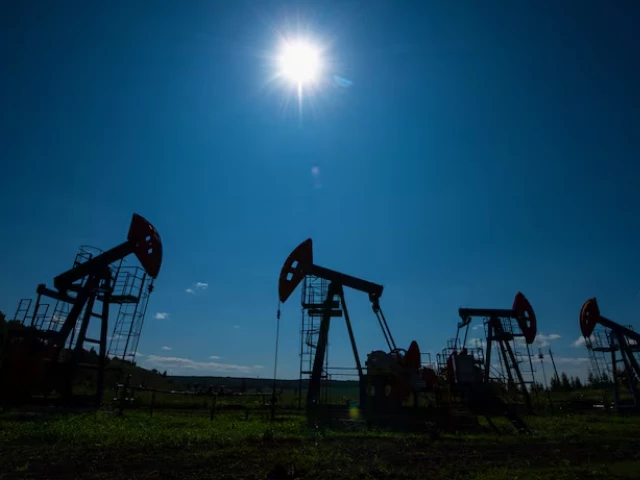
A view shows oil pump cylinders outside Almetyevsk, in the Republic of Tatarstan, Russia, July 14, 2025. Photo: Reuters
ISLAMABAD:
Pakistan currently has sufficient reserves of crude oil for 11 days, diesel for 21 days, gasoline for 27 days, LPG for nine days and jet fuel (JP-1) for 14 days, the petroleum secretary informed the Senate Standing Committee on Oil on Monday, amid growing concerns over supply disruptions caused by the Middle East conflict.
Addressing the committee, the official said Pakistan was in talks with Iran to obtain permission for oil shipments to pass through the Strait of Hormuz. If permission is granted, four Pakistani ships could carry oil cargoes through this route.
He also warned that Pakistan may face a severe gas shortage after April 14 due to disruption in LNG supplies. Meanwhile, the government has decided to provide a subsidy of 23 billion rupees to motorcycle and rickshaw owners using savings generated by its austerity policy.
The Senate Standing Committee on Petroleum met under the chairmanship of Senator Manzoor Ahmed and was briefed on the regional situation and its impact on Pakistan’s energy supplies.
The petroleum secretary said that nearly 70 percent of Pakistan’s petroleum products were imported from the Middle East. However, the ongoing conflict has affected shipping routes and supply chains.
He told the committee the price of high-speed diesel had increased from $88 to $187, while the price of gasoline had increased from $74 to $130. Normally, oil shipments from Arab countries arrive in Pakistan within four to five days, but cargoes routed via the Red Sea now take around 12 days.
The official said the country currently has reserves of crude oil for 11 days, diesel for 21 days, gasoline for 27 days, LPG for nine days and JP-1 fuel for 14 days. The government is trying to optimize the use of existing reserves, while temporary permission has also been granted to import oil below the Euro-5 quality standard.
According to the oil secretary, crude oil prices stood at $72 per barrel before the war, but rose to $88 on the second day of the conflict and have now climbed to $115 per barrel. Negotiations with Iran continue to allow oil shipments through the Strait of Hormuz, which could allow four Pakistani ships to carry crude cargoes.
The committee was also told that gas supplies to Qatar had been completely suspended. Of the eight LNG shipments expected in March, only two reached Pakistan, while six did not reach Pakistan due to the war. Likewise, of the six shipments expected in April, three may also not arrive.
Under the current circumstances, officials have warned that Pakistan may face a severe gas shortage after April 14.
Gas authorities also briefed the committee on an emergency supply plan, saying overall gas supplies were expected to fall from 683 million cubic feet per day to 672 million cubic feet per day. To manage the shortages, the government plans to increase gas supplies to domestic consumers while reducing supplies to the commercial sector, process industries and captive power plants.
The officials added that Pakistan had an agreement with an Azerbaijani company to import LNG if demand increased, even though LNG from that source would be nearly three times more expensive.
The oil secretary further told the committee that the government had decided to provide a subsidy of Rs 23 billion from the savings generated by its austerity policy. The subsidy will be extended to around 30 million motorcycle and rickshaw owners and will be distributed to eligible beneficiaries using data from the Benazir Income Support Program.
Officials of the Oil and Gas Regulatory Authority (Ogra) and the Petroleum Division have started working on the subsidy mechanism. They said savings from austerity measures would be used to fund the grant, similar to relief packages introduced during the Covid-19 pandemic.
Committee members questioned where the Rs23 billion subsidy would come from and what measures had generated the savings, insisting that any financial benefit should accrue to the public rather than businesses.
The officials responded that various cost-saving measures had been implemented under the directives of the Prime Minister.
Government monitors oil stocks
Furthermore, the government has decided to carry out a daily review of oil reserves in order to closely monitor the energy situation.
A committee monitoring petrol prices was told that Pakistan remains “adequately positioned in terms of fuel availability”, with March requirements fully guaranteed and supply cover available until mid-April under current freight planning.
According to a statement issued by the Ministry of Finance, the committee reviewed the national inventory of crude oil and refined petroleum products, import modalities and supply chain logistics.
Officials told the meeting that the country had “comfortable stocks of crude oil and key petroleum products for March, with sufficient planning in place to ensure continued availability in April.” Efforts are also underway to expand coverage towards the end of April.
The meeting, chaired by Finance Minister Muhammad Aurangzeb at the Finance Division, was part of the government’s daily review of the energy sector amid tensions in the Middle East.
During the session, procurement models and maritime logistics were also reviewed, with the committee highlighting the need to diversify sources of oil imports to strengthen Pakistan’s energy supply chain.
Officials said procurement strategies were already moving towards greater diversification to reduce reliance on a single supply corridor.
Finance Minister Aurangzeb assured that the government remains “fully focused on ensuring uninterrupted availability of petroleum products across the country”, adding that “the current stock situation and supply outlook remains stable”.
He stressed that “there is no reason to panic buy or stockpile fuel unnecessarily.”
Authorities, in coordination with Ogra and provincial governments, have been tasked with closely monitoring market activity and inventory levels to prevent hoarding.
“It was emphasized that any attempts to create artificial shortages or disrupt normal supply would be dealt with in strict accordance with the law,” the statement said.
Participants in the meeting included Oil Minister Ali Pervaiz Malik, Maritime Affairs Minister Muhammad Junaid Anwar Chaudhry, State Bank of Pakistan Governor Jameel Ahmad and other senior officials.


