
Trump will chair the BoP with extensive powers; member states must contribute $1 billion
ISLAMABAD:
Pakistan has been invited to join the United States’ recently announced Gaza Peace Council (BoP), a powerful international body tasked with overseeing the post-war transition, reconstruction and security restructuring in Gaza, the Foreign Ministry confirmed on Sunday.
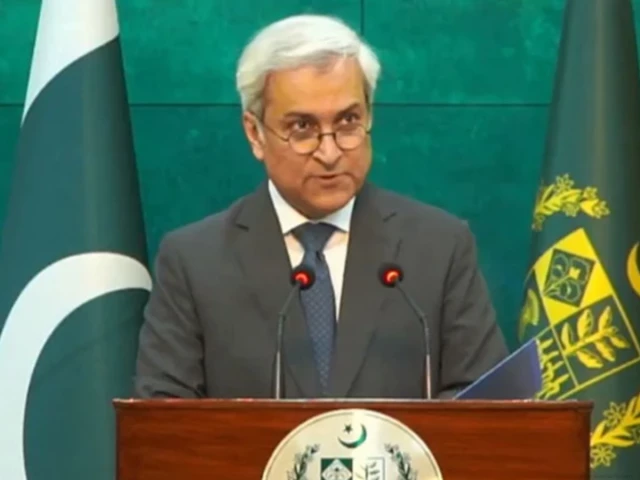
Foreign Ministry spokesperson Tahir Andrabi said US President Donald Trump formally invited Prime Minister Shehbaz Sharif to be part of the proposed BoP, highlighting Islamabad’s continued engagement in international efforts to bring peace and stability to Gaza.
“Pakistan will remain committed to international efforts for peace and security in Gaza, leading to a lasting solution to the Palestinian issue in accordance with United Nations resolutions,” Andrabi said, while responding to media questions.
The invitation places Pakistan among a select group of countries being courted by Washington as it rolls out what officials describe as an ambitious and far-reaching peace plan for Gaza, designed to end the war, rebuild the devastated enclave and establish a new governance and security framework for Gaza after the conflict.
The White House officially unveiled the structure and initial composition of the BOP on Friday. Some observers believe the initiative resembled “a sort of mini-UN”, initially focused on Gaza but with the potential to expand its mandate to other conflict zones in the future.
According to U.S. officials, the BoP will serve as the central political and financial authority overseeing Gaza’s transition phase, working alongside a technocratic Palestinian administration, international security forces and a reconstruction mechanism funded by global contributors.
The development has been widely interpreted in diplomatic circles as a bold attempt by the Trump administration to reshape postwar governance in Gaza, while asserting greater U.S. control over traditionally U.N.-led peacebuilding mechanisms.
Officials in Islamabad view the invitation as international recognition of Pakistan’s long-standing principled position on Palestine. “The world has recognized Pakistan’s consistent and principled position on Palestine,” a senior official said, stressing that Pakistan’s inclusion reflects growing confidence in its diplomatic credibility and responsible role globally.
Discussions are currently underway among Pakistani leaders regarding the US-proposed Gaza peace plan and the resulting administrative and diplomatic mechanisms, including the BoP. These mechanisms aim to end hostilities, restore governance, provide humanitarian assistance and undertake large-scale reconstruction in the Palestinian territory.
Diplomatic sources said Pakistan’s potential participation would not be driven by bloc politics, but by its commitment to alleviating the suffering of Palestinian civilians and supporting a just and lasting political settlement based on international law.
The White House said the BoP’s founding members include U.S. Secretary of State Marco Rubio, U.S. Special Envoy Steve Witkoff, former British Prime Minister Tony Blair and Jared Kushner, President Trump’s son-in-law and a key architect of previous Middle East initiatives.
Other prominent figures include Marc Rowan, CEO of Apollo Global Management; World Bank Group President Ajay Banga; and US Deputy National Security Advisor Robert Gabriel.
Leaders from more than 60 countries have been invited to serve on the broader Peace Council. Canadian media reported that Prime Minister Mark Carney accepted the invitation. Argentine President Javier Milei publicly confirmed his participation, calling it an “honor” and saying Argentina would stand with countries that “confront terrorism head-on and promote peace and freedom.”
Turkey also confirmed having received a formal invitation. Presidential Spokesperson Burhanettin Duran said President Recep Tayyip Erdogan was invited as a founding member. Egypt said it was considering an invitation for President Abdel Fattah el-Sissi, while Jordan confirmed that King Abdullah II was also invited and that consultations were underway.
Under the US plan, Gaza would be administered during a transition period by a Palestinian technocratic body known as the National Committee for the Administration of Gaza (NCAG). The body will be headed by Dr. Ali Sha’ath, former Palestinian Authority deputy minister of Khan Younis.
The NCAG will oversee the restoration of public services, reconstruction of civil institutions and stabilization of daily life, while laying the foundations for long-term governance.
Former UN Middle East envoy Nickolay Mladenov has been named high representative for Gaza, serving as a key link between the BoP and the NCAG, with significant executive power on the ground.
Security will be provided by an International Stabilization Force (ISF), commanded by American Major General Jasper Jeffers, current head of American special forces. The ISF will lead security operations, support “complete demilitarization” and ensure the safe delivery of humanitarian aid and reconstruction materials.
A separate Gaza executive council was also formed, bringing together regional and international actors, including Turkish Foreign Minister Hakan Fidan, Qatari diplomat Ali Al-Thawadi, Egyptian General Hassan Rashad, UAE Minister Reem Al-Hashimy, Dutch diplomat Sigrid Kaag and Israeli businessman Yakir Gabay.
The initiative, however, has sparked controversy, particularly over its financing and governance model.
According to a draft charter seen by Bloomberg, the Trump administration is asking countries seeking a permanent seat at the BoP to contribute at least $1 billion. President Trump would be the first chair of the BoP and would retain decisive authority over membership and decision-making.
Under the plan, each member state would have one vote, with decisions taken by majority, but all outcomes would remain subject to the president’s approval. The duration of membership would normally be limited to three years, unless a country contributes more than $1 billion in cash in the first year, in which case the duration limit would not apply.
The charter describes the BoP as “an international organization that seeks to promote stability, restore reliable and lawful governance, and ensure lasting peace in areas affected or threatened by conflict.” The body will become official once three states sign the charter.
A U.S. official confirmed to Bloomberg News that while countries could join without paying, the $1 billion contribution would guarantee permanent membership. The funds, the official said, would be used directly for the reconstruction of Gaza, with assurances that “almost every dollar” would be dedicated to carrying out the BoP’s mandate.
Critics argue that this structure effectively gives President Trump disproportionate control, raising fears that the BoP could become a rival to the United Nations, an institution that Trump has repeatedly criticized. Some European and regional countries have reportedly expressed serious reservations about the draft charter.
According to people familiar with the discussions, several states are working collectively to oppose provisions that would place financial control and agenda-setting powers almost entirely in the hands of the president. Israeli Prime Minister Benjamin Netanyahu also criticized the initiative, saying its details had not been coordinated with Israel.
Pakistan has consistently called for an immediate ceasefire in Gaza, unhindered humanitarian access, accountability for violations of international humanitarian law, and a two-state solution leading to an independent Palestinian state. The officials said Islamabad would carefully assess the structure, mandate and implications of the BoP before deciding on the nature of its engagement.
Analysts say Pakistan’s participation could allow it to go beyond declarations and play a practical role in shaping humanitarian aid, reconstruction transparency and policy outcomes. “It is an honor, a vote of confidence and a responsibility,” said a senior diplomat. “If managed judiciously, Pakistan’s role could contribute significantly to safeguarding Palestinian interests and advancing a just and lasting peace.”


