
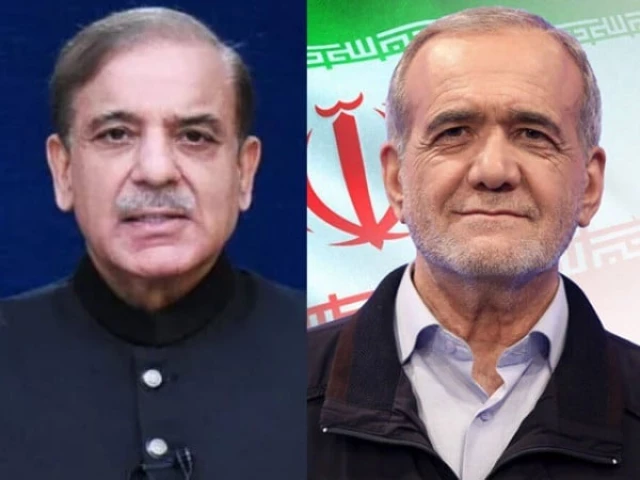
A combined photo of Prime Minister Shehbaz Sharif and Iranian President Masoud Pezeshkian. PHOTOS: FILE
ISLAMABAD:
As tensions continue to grip the Middle East following US-Israeli strikes on Iran, Pakistan is attempting a delicate diplomatic balancing act, engaging Tehran at the highest level while reiterating its long-standing strategic commitment to Saudi Arabia.
Prime Minister Shehbaz Sharif on Wednesday held a telephone conversation with Iranian President Masoud Pezeshkian to discuss the developing regional situation, highlighting Islamabad’s diplomatic efforts amid fears of a wider conflict.
At the same time, the Prime Minister’s spokesperson to foreign media said that Pakistan stands firmly with Saudi Arabia.
According to an official statement, the Prime Minister, in a telephone call with the Iranian President, expressed deep concern over the rising tensions and stressed that dialogue and diplomatic engagement remained essential to ensure peace and stability in the region.
“Pakistan views diplomatic efforts and dialogue as essential to ensure peace, stability and de-escalation,” Shehbaz said during the call, calling on all parties to exercise restraint and responsibility to prevent further deterioration of the situation.
The conversation comes at a time when the region is experiencing increased volatility following the escalation between Iran and the US-Israel alliance, raising concerns about broader geopolitical repercussions and potential disruptions to global energy supplies.
During the call, the prime minister also highlighted Pakistan’s long-standing ties with Iran, stressing that Islamabad attaches great importance to its “historical, religious and cultural relations” with Tehran and seeks to further strengthen bilateral cooperation.
He reaffirmed Pakistan’s commitment to expanding relations with Iran in multiple sectors and maintaining high-level contacts between the two countries.
President Pezeshkian, in turn, expressed Iran’s desire to deepen its relations with Pakistan and stressed the importance of working together to promote regional peace and stability. He also briefed the Pakistani Prime Minister on Iran’s position regarding recent regional developments.
“Tehran does not intend to enter into conflict with regional countries,” state media quoted the Iranian president as saying.
The two leaders agreed to stay in close contact and continue consultations as the situation evolves, while exploring opportunities to expand cooperation between neighboring countries.
The diplomatic move follows Shebaz’s letter earlier this week to Iran’s new supreme leader, Mojtaba Khamenei, in which he congratulated him for assuming leadership following the assassination of his father, Ali Khamenei.
While maintaining its engagement with Tehran, Islamabad has also reaffirmed its deep strategic ties with Riyadh.
Prime Minister’s Foreign Media Spokesperson Mosharraf Zaidi said Pakistan would stand firmly with Saudi Arabia if necessary, emphasizing the depth of bilateral relations.
“The question is not whether Pakistan could come to the aid of Saudi Arabia,” Zaidi said in an interview with Bloomberg. “Both countries have long operated on the principle of being there for the other before needing the other.”
“So there is no doubt that we could do it; we will do it. Whatever happens, it doesn’t matter when,” he added.
Zaidi, however, stressed that Pakistan’s immediate priority was to prevent further escalation of the situation and ensure that key regional partners were not drawn into a wider conflict.
“The real question is what Pakistan is doing to ensure that the situation does not escalate to the point where one of its closest partners becomes even more embroiled in conflict,” he said.
He revealed that Pakistan was maintaining contacts with Saudi and Iranian leaders amid the crisis and highlighted its recent diplomatic engagements, including Pakistan Army Chief Asim Munir’s visit to Saudi Arabia.
Zaidi also praised Gulf states for resisting external pressure to become directly involved in the conflict.
“There have been calls for Gulf Cooperation Council countries to become actively involved,” he said, adding that their restraint was supported by Pakistan.
At the same time, he acknowledged the strong economic and strategic partnership between Islamabad and Riyadh, noting that Saudi Arabia had already helped Pakistan stabilize its energy supply chain during the crisis.
According to Zaidi, disruptions to regional shipping routes could delay fuel shipments to Pakistan from the usual five to six days to almost three weeks if alternative routes are used.
Saudi Arabia, he said, intervened to ensure Pakistan’s access to oil, diesel and crude supplies, highlighting the depth of cooperation between the two countries.
He also highlighted the government’s recent austerity measures aimed at dealing with the economic fallout of the regional crisis, including a four-day work week, expanded work-from-home arrangements and a significant reduction in the use of government vehicles.
“Every crisis is an opportunity for change,” Zaidi remarked.


