
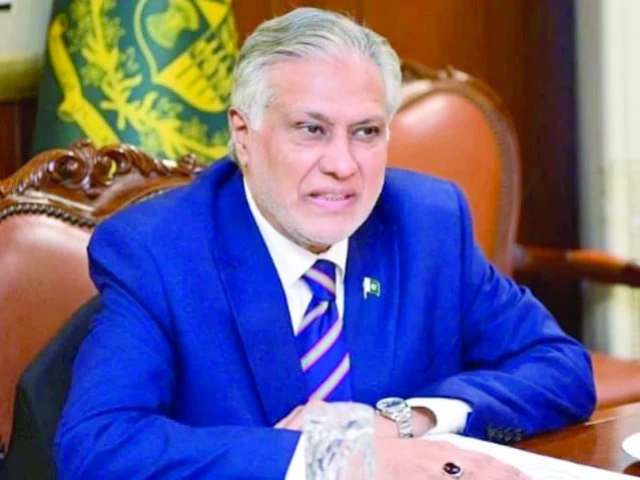
In another opening of peace, Pakistan again extended the Olivier branch to the Arc-Rival of India on Tuesday and offered a composite dialogue with New Delhi to solve the problems pending between the two nuclear arms neighbors.
The last offer was extended by the Minister of Foreign Affairs Ishaq Dar. Addressing a press conference in New York, he said that dialogue is not limited to terrorism, stressing that Pakistan was one of the greatest victims of terrorism.
DAR also noted that US Secretary of State Marco Rubio had recognized Pakistan’s sacrifices in the war against terrorism during a recent meeting.
The Deputy Prime Minister also developed that during the bilateral meeting with Rubio, the long-standing dispute of Jammu and Kashmir has also been discussed.
He pointed out that permanent peace in the region is not possible without a resolution of the cashmere issue, recalling that US President Donald Trump had raised the issue several times.
Speaking on the industrial waters treaty, the Minister of Foreign Affairs said that the position of Islamabad was clear: the treaty is binding and that no party can finish or change it unilaterally. He reiterated the previous warnings of the country’s leaders that any attempt to divert or block the share of Pakistan water would be unacceptable.
Answering another question, Dar said Pakistan did not intend to recognize Israel. He called for an immediate cease-fire in Gaza and the delivery of humanitarian aid to the Palestinian people.
He also reaffirmed the unwavering support of Pakistan to the creation of an independent and sovereign Palestinian State, with al-Quds Al-Sharif as capital.
DAR described its visit to the United States as successful, noting that Pakistan had raised the voice of the reforms to the United Nations Security Council and stressed that the Islamic Cooperation Organization (OCI) was to be granted to a representation due to the World Organization.
The recent conflict between Pakistan and India has marked a major military climbing between the two nuclear powers.
The tension between Pakistan and India increased after the Attack on Pahalgam on April 22 in Jammu and Kashmir (iiojk), which killed 26 tourists.
New Delhi immediately blamed Islamabad without providing any evidence. He also took a major series of diplomatic measures to demarcate his links with Pakistan.
Read: India hardens the position on Pahalgam’s attack
Islamabad denied the allegations and offered an impartial investigation into the incident.
On the night of May 7, the Indian Air Force launched an attack not caused against civilian targets in Pakistan. Pakistan Air Force (PAF) immediately retaliated and killed at least six IAF planes, including three gusts built in French.
Find out more: Decoding of defeat: five times Indian military officials have admitted losses against Pakistan
Starting further, on the night of May 9 to 10, India launched another series of strikes against Pakistan, but this time targeted military and bases.
In retaliation, Pakistan launched Operation Bunyanum Marsoos, hitting in Indian military facilities, including missile storage sites, bases and other strategic targets. The strikes early in the morning were a shock for Indian military leadership, which underestimated Pakistan’s response to their uninsured attacks.
While the conflict has evolved, US President Donald Trump announced on May 10 that a ceasefire had been reached as a result of intense diplomatic efforts overnight. The two parties gradually reduced the number of troops from the international border in the following weeks.
A tense calm prevails between the two countries, India continuing to publish benevolent declarations.


