
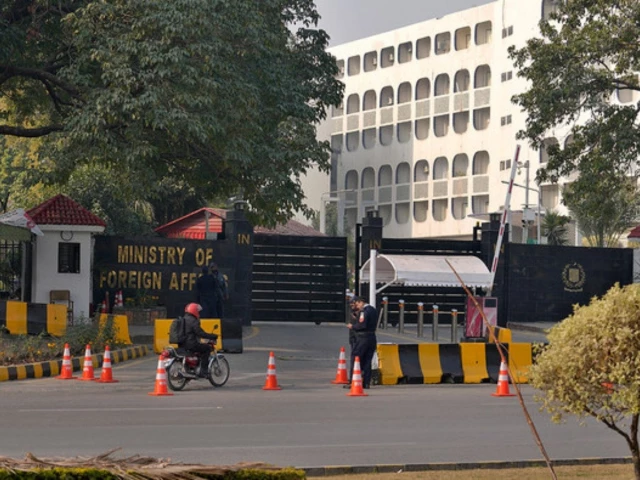
Police officers stand guard outside the main gate of the Ministry of Foreign Affairs in Islamabad on January 18, 2024. Photo: File
ISLAMABAD:
Pakistan has acknowledged that it is actively seeking diplomatic avenues to help end the ongoing war in the Middle East, while warning against media speculation that could undermine sensitive efforts requiring discretion.
In an exclusive conversation with The Express PK Press Club On Tuesday, Ministry of Foreign Affairs (FO) spokesperson Tahir Andrabi said Islamabad remained firmly committed to resolving the conflict through dialogue and engagement, in line with its long-standing foreign policy principles.
“Pakistan, in line with its long-standing policy, remains committed to resolving the ongoing conflict in the Middle East and the Persian Gulf through diplomatic means and engagements,” Andrabi said.
He stressed, however, that such efforts require confidentiality. “Diplomacy and negotiations often require that certain issues be advanced with discretion,” he noted, calling on the media to refrain from speculation and wait for official announcements.
Read: Pakistan presents itself as the main peace mediator
Pakistan’s cautious public stance comes as it quietly emerges as a key player seeking to end the escalating conflict between the United States and Iran. According to American media and officials close to the matter, Islamabad is positioning itself as a potential venue for negotiations between Tehran and Washington.
The diplomatic opening follows US President Donald Trump’s announcement of a temporary cessation of hostilities, citing what he described as “constructive engagement” with Iran. Immediately afterwards, reports suggested that Pakistan, Turkey and Egypt had stepped up efforts to facilitate indirect messaging between the two adversaries.
According to AxiosIslamabad is being considered for possible negotiations involving a US delegation that could include special envoy Steve Witkoff and Jared Kushner, alongside senior Iranian leaders, potentially including the speaker of Parliament. Tehran, however, has publicly rejected any suggestion of direct or indirect negotiations with Washington.
Yet diplomatic activity over the past 24 hours indicates a flurry of behind-the-scenes engagements, suggesting otherwise.
Pakistan’s civilian and military leadership remained actively engaged with key stakeholders. Prime Minister Shehbaz Sharif held a telephone conversation with Iranian President Masoud Pezeshkian, reaffirming solidarity with Iran while calling for restraint and dialogue.
Learn more: Trump postpones threat to bomb Iran’s power grid as Pakistan, Turkey and Egypt mediate to end conflict
According to an official statement, the Prime Minister extended his Eidul Fitr and Nowruz greetings to the leaders and people of Iran, while expressing condolences over the loss of lives in the ongoing conflict. He warned of the “dangerous” trajectory of hostilities in the Gulf and stressed the urgent need for collective efforts to defuse tensions through diplomacy.
Above all, he stressed the need for unity within the Muslim world, affirming that cohesion within the Umma was “more critical than ever” in the context of the ongoing crisis.
Sharing details of Pakistan’s diplomatic moves, Prime Minister Shehbaz assured Tehran that Islamabad would continue to play a constructive role in facilitating peace and stability.
Meanwhile, the country’s military leaders also engaged Washington. A report in the Financial Times said Chief of Defense Force and Chief of Army Staff Field Marshal Syed Asim Munir held a telephonic conversation with President Trump to discuss the developing situation.
Diplomatic sources said the contacts reflected Pakistan’s attempt to leverage its unique ties with Tehran and Washington to create space for dialogue.
At the same time, Deputy Prime Minister (DPM) and Foreign Minister (FM) Ishaq Dar led a hectic diplomatic campaign, speaking separately to his Iranian counterpart Abbas Araghchi and Turkish Foreign Minister Hakan Fidan. During both conversations, Dar emphasized dialogue and diplomacy to ensure peace and stability, with all parties agreeing to remain in close contact.
Also read: JI chief urges Pakistan to support Iran-US talks, warns of ‘Trump deception’
These parallel engagements, also involving Turkey and Egypt, demonstrate a coordinated but still nascent mediation effort, largely focused on indirect messaging rather than a formal negotiation process.
While there has been no official confirmation from Islamabad about hosting the talks, sources have not ruled out the possibility, suggesting that Pakistan is willing to provide a neutral venue if necessary.
Analysts warn, however, that despite the diplomatic turmoil, prospects for a breakthrough remain uncertain given the deep distrust between Washington and Tehran and rapidly changing battlefield dynamics.
Nonetheless, Pakistan’s proactive diplomacy underscores its attempt to position itself as a bridge, maintaining solidarity with Iran as a neighbor while preserving strategic ties with the United States and key Gulf partners.
Since the start of the war, Pakistan has followed a tense diplomatic path, seeking to avoid being directly involved in the conflict despite its mutual defense pact with Saudi Arabia. Officials say this balancing act is precisely why Islamabad is pushing for dialogue and diplomacy.
Sources added that if Pakistan’s efforts succeed, it could amount to a major diplomatic coup.


