
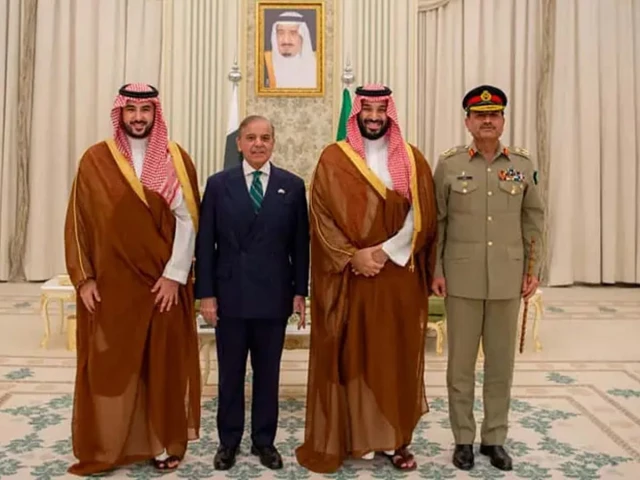
Mosharraf Zaidi says Pakistan-Saudi relations are old and based on mutual support and cooperation
Pakistan on Thursday reaffirmed its commitment to supporting Saudi Arabia whenever necessary, while emphasizing that Islamabad is also working to prevent further escalation in the Middle East.
Speaking in an interview with Bloomberg TelevisionPrime Minister Shehbaz Sharif’s spokesperson Mosharraf Zaidi highlighted the long-standing relations between Pakistan and Saudi Arabia, noting that they have always been based on mutual support and cooperation.
“One thing that needs to be very clear at the summit is that the question is not whether Pakistan could come to the aid of Saudi Arabia. I think the two countries, even before the mutual strategic defense agreement, have always operated on the principle of being there for the other before needing the other. There is no doubt that we could do it, and we will do it, whatever happens and whenever,” he said.
Tensions in the Middle East have sharply escalated after US and Israeli airstrikes assassinated Iran’s Supreme Leader Ayatollah Ali Khamenei and several senior officials last week, triggering a wave of retaliation from Tehran and widening the conflict across the region. In response to these strikes, Iran launched retaliation against US military bases in several Gulf countries, significantly expanding the scope of the confrontation.
Pakistani leaders have since stepped up diplomatic efforts to play their role in managing tensions, particularly between Iran and the Gulf states.
I spoke to @BloombergTV this morning on Pakistan’s response to the economic and supply chain challenges caused by Iran’s invasion.
I explained that the Prime Minister, Cabinet and our Marshal acted quickly and decisively, ensuring iA had robust and continued supply and inventory. pic.twitter.com/y6bWHJ39WT
– Mosharraf Zaidi 🇵🇰 (@mosharrafzaidi) March 11, 2026
Zaidi said Pakistan was working to prevent a wider regional conflict that could further destabilize the Middle East and affect its own interests.
“The real question is what is Pakistan doing to ensure that things do not get to the point where one of its closest partners finds itself further embroiled, drawn into a conflict that could potentially undermine stability and prosperity, not only for the region as a whole, but especially for the people of Pakistan,” he added.
He said Pakistan had actively engaged regional and global partners in recent days. Chief of Defense Forces (CDF) Field Marshal Asim Munir visited Saudi Arabia recently, while Islamabad also remained in touch with Iranian leaders and maintained dialogue with the United States.
“I think over the last six or seven days there’s been a whole series of conversations. And I have to say, one of the things that I think the Pakistanis really admire is the way that Saudi Arabia and the other Gulf states have resisted being drawn in,” he said.
Zaidi noted that some voices in the United States had urged Gulf states to become more actively involved in the conflict, but that regional governments had so far avoided deeper involvement.
“We’ve seen all kinds of calls from some people in the United States and elsewhere for the Saudis and other GCC countries to get more actively involved. But they’ve resisted. And I think, in part, that’s part of what Pakistan wants to see bigger,” he said.


