
Sargodha:
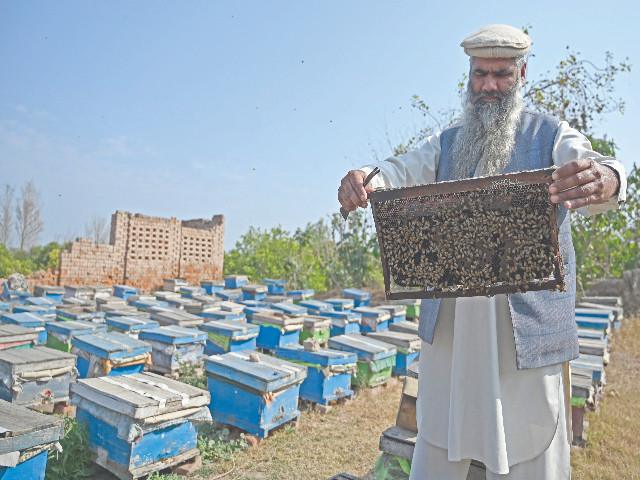
Under a dry sky and smoggy, a beekeeper in the province of Punjab in Pakistan carefully charges boxes filled with tens of thousands of bees at the back of a truck.
Together, they will travel 500 kilometers (around 300 miles) in an increasingly desperate pursuit to find flower plants, pure air and moderate temperatures for honey production, because climate change and pollution threaten the industry.
“We move the boxes according to the place where the weather is good and the flowers flourish,” said Malik Hussain Khan to AFP, standing in an orange field whose flowers arrived from weeks at the end of February and only lasted a few weeks.
Pakistan beekeepers generally move seasonally to save their stifling heat or freezing cold.
The summers have passed in the northwest of the province of Khyber-Pakhtunkhwa and winters in the central province of Punjab.
But the weather conditions made unpredictable by climate change – associated with some of the worst pollution in the world – nasty beekeepers must move more frequently and travel further.
This winter was marked by levels of arrow and dangerous smog that the government declared a national disaster. Research has revealed that air pollution can make it more difficult for bees to locate flowers.
The decrease in precipitation, on the other hand, failed to eliminate the air from suffocation and triggered drought warnings for farmers.
“Almost half of my bees died when the SMOG and the fog struck this winter because they could not fly. There was practically no rain,” said Khan, who moved his bees as often as every few weeks of January and February.
The bees of the 27,000 beekeepers in Pakistan once had diversified foliage powered by reliable precipitation, offering a rich source of nectar.
Their honey is used in remedies against local flu, sprinkled with candy and given in gifts.
Since 2022, however, the production of honey from Pakistan has dropped by 15%, according to the Honey Bee Research Institute (HBRI) of the government in the capital Islamabad.
“Strong precipitation and hail storms can destroy flowers, and erratic precipitation and high temperatures during the winter flowering season can prevent them from flowering,” Muhammad Khalid, researcher at the Institute said.
“When the flowers disappear, the bee population decreases because they cannot find a nectar, resulting in a reduction in honey production.”
Bees are threatened globally by the evolution of weather conditions, intensive agricultural practices, the change of land use and pesticides.
Their loss threatens not only honey trade, but food security in general, with a third of global food production depending on the pollination of bees, according to the organization of food and agriculture.
Pakistan bees produced 22 varieties of honey, but that dropped to 11 as the flowering seasons are shortened. Three of the four species of honey bees in the country are threatened.
“The places that were green for our bees to fly 30 years ago, are no longer so,” said Sherzaman Momaan, a 52 -year -old honey trader, who speaks with tenderness of his winged charges.
“We did not move at that time as much as we do now.”
His hives were almost entirely destroyed by the 2010 floods at Khyber Pakhtunkhwa, but he thinks that deforestation is the most significant change and threat in the long term.
Yousaf Khan and his brother, based in Islamabad, have been producing honey for 30 years, moving short distances around the neighboring Punjab to take the best flowers. “Now we are going to Sindh (province) for warmer temperatures and to escape extreme weather conditions,” Khan told AFP, referring to areas up to 1,000 kilometers (600 miles).
“Bees are like babies, they need a good environment, a good environment and good food to survive.”
Moving the bees is accompanied by its own risks.
“If the weather is very hot, or if the distance is too long, there is a chance that some bees can die. It has happened to my bees before,” said Khan.
During long trips, they must also be fed on artificial food because they cannot produce honey on a trip.


